X-shear regarding the origin - 2-d and 3-d transformations, Computer Graphics

Assignment Help:

X-shear Regarding the Origin - 2-d and 3-d transformations

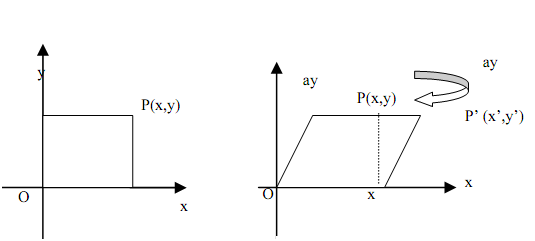
Suppose an object point P(x,y) be moved to P'(x',y') in the x-direction, via the given scale parameter 'a',that is, P'(x'y') be the outcome of x-shear of point P(x,y) through scale factor a regarding the origin, that is demonstrated in Figure 4.
1873_X-shear Regarding the Origin - 2-d and 3-d Transformations.png

Hence, the points P(x,y) and P'(x',y') have the subsequent relationship:

x' = x + ay

y' = y         

= Shx(a)                                                    ------(11a)

Here 'a' is a constant (termed as shear parameter) which measures the degree of shearing.  The shearing is in the opposite direction, if a is negative.

Remember that P(0,H) is taken into P'(aH,H).  This obeys that the shearing angle A which is the angle by that the vertical edge was sheared; is specified by:

tan(A) = aH/H = a.

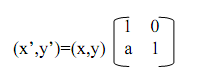
Consequently the parameter a is simply the tan of the shearing angle. Within matrix form of 2-D Euclidean system, we contain:
1131_X-shear Regarding the Origin - 2-d and 3-d Transformations 1.png

(12)

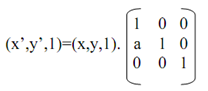
In terms of Homogeneous Coordinates, above equation (12) is:
456_X-shear Regarding the Origin - 2-d and 3-d Transformations 2.png

-----------------------(13)

That is, P'h = Ph Shx(a)   --(14)

Here Ph and P'h represent object points, before and after needed transformation, in Homogeneous Coordinates and Shx(a) is termed as homogeneous transformation matrix for x-shear along with scale parameter 'a' in the x-direction.


Related Discussions:- X-shear regarding the origin - 2-d and 3-d transformations

Rotation about z-axis - transformation for 3-d rotation, Rotation about z-a...

Rotation about z-axis - Transformation for 3-d rotation Rotation about z-axis is explained by the xy-plane. Suppose a 3-D point P(x,y,z) be rotated to P'(x',y',z') along with

How to use illumination model to calculate vertex intensity, How to utilize...

How to utilize illumination model to calculate vertex intensity: For such we interpolate intensities beside the polygon edges, for all scan line the intensity at the intersecti

Define pixel and frame buffer, Define pixel and frame buffer? Pixel is ...

Define pixel and frame buffer? Pixel is shortened forms of picture element. Every screen point is referred to as pixel or pel.  Picture definition is kept in a memory area c

Describe the artwork-advert as accurately as possible, Question: (a) S...

Question: (a) Some adverts are set up only with facts and with no use on concepts/emotions. Name and explain two strengths and two weaknesses of "no use of emotions in

CRT, Explain working of CRT

Explain working of CRT

Explain about the computer animation, Explain about the Computer animation ...

Explain about the Computer animation Computer animation is the art of creating moving images by computer software and hardware. For 3D animation, objects are designed on a

Phong shading or normal vector interpolation shading, Phong shading OR Norm...

Phong shading OR Normal Vector Interpolation Shading In Gouraud shading we were doing direct interpolation of intensities although a more exact method for rendering a polygon

Adobe photoshop - softwares for computer animation, Adobe Photoshop - Softw...

Adobe Photoshop - Softwares for computer animation Whereas Adobe Photoshop is not a computer animation application, this is one of the top of the line graphics programs. This

Write Your Message!

Captcha
Free Assignment Quote

Assured A++ Grade

Get guaranteed satisfaction & time on delivery in every assignment order you paid with us! We ensure premium quality solution document along with free turntin report!

All rights reserved! Copyrights ©2019-2020 ExpertsMind IT Educational Pvt Ltd