Scientific Visualization
This is complex for the human brain to create sense out of the large volume of numbers produced through a scientific computation. Statistical and numerical methods are helpful for solving this problem. Visualization techniques are the other approach for interpreting large data sets, giving insights that might be missed through statistical methods. The pictures they offer are a vehicle for thinking regarding the data.
Since the volume of data accumulated from computations or from recorded measurements raises, this becomes more significant that we be capable to make sense out of that data quickly. Scientific visualization, utilizing computer graphics, is one manner to do this.
Scientific visualization engages interdisciplinary research into robust and effectual computer science and visualization tools for resolving problems in aeronautics, biology, medical imaging, and another discipline. The profound scientific computing impact upon virtually all areas of engineering and science has been well established. The rising complexity of the fundamental mathematical models has also highlighted the serious role to be played through scientific visualization. Therefore, it comes as no surprise like Scientific visualization is one of the most active and exciting regions of Computing Science and Mathematics and certainly one that is only beginning to mature. Scientific visualization is a technology that helps to understand and explore scientific phenomena objectively, visually and quantitatively. Scientific visualization permits scientists to think regarding the unthinkable and visualize the unviable. Through this we are seeking to know data. We can create beautiful graphs and pictures; we can add scientific information as temperature, velocity or exhaust emission to an existing thing hence becoming a scientific visualization product.
Hence, we can say scientific visualization is a scientist's tool kit that helps to reproduce insight and understanding of any scientific problem, therefore, helping not only in resolving or analyzing similar but also generating appropriate presentations of similar. This idea of scientific visualization fits suitable with simulation and modeling. The following figure describes steps for visualization of any scientific issue under consideration; these steps are followed recursively to visualize any complicated situation.
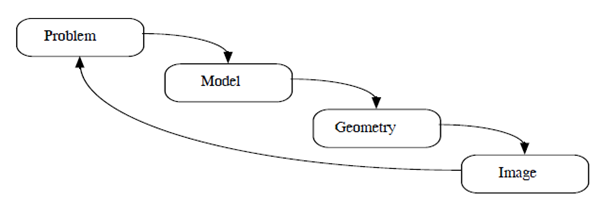
Figure Steps for Visualisation of any scientific problem
Thus, computer graphics has become a significant part of scientific computing. A huge number of software packages here exist to help the scientist in rising graphical presentations of their data. Several of the tools or packages utilized to express the graphical effect for modeling and simulation of any scientific visualization are as:
- Matlab (by The Math Works Inc.)
- Mathematica or Maple (graphical computer algebra system) Stella (models dynamic systems)
- IDS (Interactive Data Systems) by Research System Inc.
AVS (Application Visualisation System) by Advance visual System