Relation between 2-d euclidean system and homogeneous system, Computer Graphics

Assignment Help:

Relation between 2-D Euclidean system and Homogeneous coordinate system

Suppose that P(x,y) be any point in 2-D Euclidean system. In HCS, we add a third coordinate to the point. In place of (x,y), all points are represented via a triple (x,y,H) so H≠0; along with the condition as (x1,y1,H1)=(x2,y2,H2) ↔ x1/H1 = x2/H2 ; y1/H1 = y2/H2. In two dimensions the value of H is generally remained at 1 for simplicity. If we take H=0 now, then this presents point at infinity, which is generation of horizons.

The subsequent table demonstrates an association between 2-D Euclidean (Cartesian coordinate) system and Homogeneous coordinate system.

2-D Euclidian System                                        Homogeneous Coordinate System (HCS)

Any point (x,y)                         →                                             (x,y,1)

If (x,y,H) be any point in HCS(such that H≠0);

                                                                                    then (x,y,H)=(x/H,y/H,1), which is

(x/H,y/H)                        ←                                                                     (x,y,H)

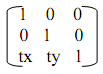
Any one point (x,y) → (x+tx,y+ty) in 2-D Euclidian system. By using Homogeneous coordinate system, this translation transformation can be presented as (x,y,1) → (x+tx,y+ty,1). In two dimensions the value of H is generally maintained at 1 for simplicity. Here, we are capable to represent this translation transformation in matrix form as:
242_Relation between 2-D Euclidean (Cartesian) system and Homogeneous coordinate system 2.png

 (x',y',1)=(x,y,1)

P'h=Ph.Tv    

Here P'h and Ph   demonstrate here object points in Homogeneous Coordinates and Tv is termed as homogeneous transformation matrix for translation. Consequently, P'h, the new coordinates of a transformed object, can be determined by multiplying earlier object coordinate matrix, Ph, along with the transformation matrix for translation Tv.

The benefit of initiating the matrix form of translation is to simplify the operations on complicated objects which are, we can now build complicated transformations by multiplying the basic matrix transformations. Such process is termed as concatenation of matrices and the resulting matrix is frequently referred as the composite transformation matrix.


Related Discussions:- Relation between 2-d euclidean system and homogeneous system

Characteristics of vector drawings, Characteristics of vector drawings: Ve...

Characteristics of vector drawings: Vector drawings are generally pretty small files as they include only data about the Bezier curves which form the drawing. The EPS-file format

Scan line algorithm and seed fill algorithm, Scan line algorithm and seed f...

Scan line algorithm and seed fill algorithm Two basic approaches are followed in area filling on raster systems.  In the first approach overlap intervals for scan lines that cr

Important points about the frame buffers - graphics hardware, Important Poi...

Important Points about the Frame Buffers 1) Within a frame buffer, information storage starts from top left corner and goes until the bottom right corner. 2) By using this

Do we have need of to generate full circumference of circle, 1.   Do we hav...

1.   Do we have need of to generate the full circumference of the circle utilizing the algorithm or  can we can produces it in a quadrant or octant only and after that utilization

Scan line polygon fill algorithm - raster graphics, Scan Line Polygon Fill ...

Scan Line Polygon Fill Algorithm - Raster Graphics In such algorithm, the information for a solid body is stored in the frame buffer and utilizing that information each pixel

Tablet computer - cad and cam, Tablet Computer - CAD and CAM Tablet ...

Tablet Computer - CAD and CAM Tablet Computer: it is a complete computer comprises in a touch screen. Tablet computers can be specialized for only Internet utilize or be fu

Rigid body or non-rigid body transformations, Rigid body or Non-Rigid body ...

Rigid body or Non-Rigid body Transformations 2D transformations can be classified as rigid body or non-rigid body transformations. Rigid body transformations keep the shape and

Construction of an isometric projection - transformation, Construction of a...

Construction of an Isometric Projection - Transformation In this projection, the direction of projection i.e. d = (d 1 ,d 2 ,d 3 ) makes an identical angles with all the 3-pr

Write Your Message!

Captcha
Free Assignment Quote

Assured A++ Grade

Get guaranteed satisfaction & time on delivery in every assignment order you paid with us! We ensure premium quality solution document along with free turntin report!

All rights reserved! Copyrights ©2019-2020 ExpertsMind IT Educational Pvt Ltd