Explain the periodic table of the elements, Biology

Assignment Help:

Explain the periodic table of the elements ?

Periodic Table of the Elements :  An element is a pure substance composed of atoms all of a single kind. It cannot be broken down chemically into different forms of matter. About 92 elements occur in nature, and others, with atomic numbers 93 to 112, can be made in the laboratory. Living organisms contain only about 20 elements in more than minute quantities.

Names and properties of elements are listed in a chart called the Periodic Table of the Elements. The properties of an element can be predicted to some extent by its position in the Periodic Table.
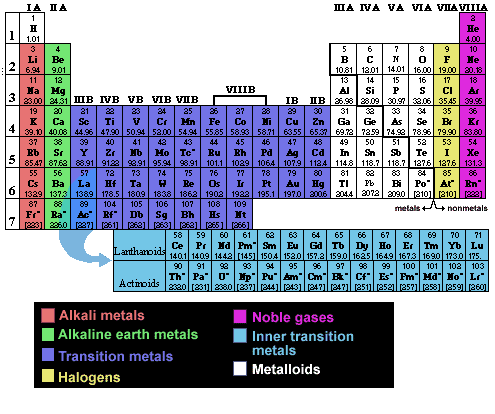
727_Periodic Table of the Elements.png

In the table, each element is represented by a symbol. The number of protons in an atom is called the atomic number, and by convention the atomic number is listed at the lower left of the symbol as a subscript. The superscript to the left upper corner of the symbol is the atomic mass (mass number), or the approximate mass of the specific isotope of that element.

Isotopes are forms of an element with different atomic masses that occur because the number of neutrons in the nucleus can vary without essentially changing chemical properties of the element. In other words, isotopes behave exactly alike in terms of how they interact electrically with other elements, even though their masses differ, because neutrons are electrically neutral.

Most elements have two or more isotopes. Most hydrogen atoms are made of one proton and one electron. However, in nature, about 1 out of every 6,500 hydrogen atoms has a neutron as well as a proton in its nucleus. This isotope is called deuterium; its symbol is written 2H.


Related Discussions:- Explain the periodic table of the elements

Development of heart in amphibians, Development of Heart in Amphibians ...

Development of Heart in Amphibians The heart and the surrounding pericardial cavity build up from lateral mesoderm. After gastrulation, the mesodermal mantles carry on to gro

What are the symptoms of congestive cardiac failure, Q. What are the sympto...

Q. What are the symptoms of congestive cardiac failure? Congestive cardiac failure is a progressive form of cardiomyopathy. The most classical symptom is fluid imbalance due to

Describe pressure controlled ventilation, Describe Pressure Controlled Vent...

Describe Pressure Controlled Ventilation (PCV) This is a pressure cycled mode (machine delivers a set pressure - the tidal volume generated depends on how compliant the lungs

How mineral salts participate in osmotic regulation, Q. How mineral salts p...

Q. How mineral salts participate in osmotic regulation? Osmotic pressure depends not on the nature of such particles and on the number of particles dissolved in a solution. Min

What is carbon cycle explain briefly, What is Carbon Cycle explain briefly?...

What is Carbon Cycle explain briefly? Life on earth is mainly carbon-based. Most of the material substances that make up living organisms consist of organic compounds of carbon

What are four initial stages of the embryonic development, Q. What are the ...

Q. What are the four initial stages of the embryonic development? The four early stages of the embryonic development are the blastula stage, the morula stage, the gastrula stag

What is selective waste collection, Q. What is selective waste collection? ...

Q. What is selective waste collection? The Recyclable waste is waste that can be reprocessed and used again. The waste recycling depends on the separation of the recyclable res

Objectives of the earth pressure and retaining structures, What are the obj...

What are the objectives of the earth pressure and retaining structures? After knowing all concepts about the same you should be able to learn: a. Know the field situations w

How age factors affecting the calcium absorption, How Age factors Affecting...

How Age factors Affecting the calcium absorption? Age is another factor which influences the absorption of calcium. Fractional absorption of calcium is highest in infancy i.e.,

Crayfish, the appendages of arthropods; a. may serve as walking legs, b. ma...

the appendages of arthropods; a. may serve as walking legs, b. may be modified into atennae, c. may be modified into large pincers, or d. all of the above

Write Your Message!

Captcha
Free Assignment Quote

Assured A++ Grade

Get guaranteed satisfaction & time on delivery in every assignment order you paid with us! We ensure premium quality solution document along with free turntin report!

All rights reserved! Copyrights ©2019-2020 ExpertsMind IT Educational Pvt Ltd