Compounds of group 16 elements, Chemistry

Assignment Help:

Q. Compounds of Group 16 Elements?

We will now discuss some compounds like the hydrides, halides and oxides of the Group 16 elements.

 All elements of this group form simple volatile binary hydrides of the type H2X (X = 0. S etc.). The simple hydride of oxygen is H2O or water. The other known hydride of oxygen is H202 hydrogen peroxide. Sulphur forms the most extensive series of catenated hydrides such as H2S, H2S2, H2S2 H2 S2 etc. Hydrides of sulphur, other than H2S, are all yellow oils which readily decompose into H2S and free sulphur. Selenium, tellurium and polonium form H2, Se, H2Te and H2Po, respectively.
2152_Compounds of Group 16 Elements.png

The reducing power of hydrides increases whereas their thermal stability decreases in the order H2O; H2S; H2, Se; H2, Te; H2Po. In fact H2Se and H2Te are better reducing agents than hydrogen.

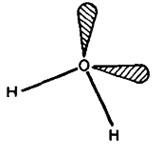
The hydride molecules are angular in shape. The bond angles in H2O, H2S, H2Se and H2Te  being 104.50. 920.910 and 89.0°, respectively. In case of H2O, oxygen is supposed to be sp7 hybridised with two lone pairs occupying two positions on the tetrahedron, Fig. The distortion from the tetrahedral angle (109028') is supposed to be due to stronger repulsion between, lone pairs of electrons compressing the bond angle. In the case of other hydrides, bond angles are close to 900 suggesting that almost pure p -orbitals are inv6lved in bonding to hydrogen.


Related Discussions:- Compounds of group 16 elements

Determine the best method of preparing a stable emulsion, Q. Determine the ...

Q. Determine the best method of preparing a stable emulsion? To determine the best method of preparing a stable emulsion like mayonnaise. • learn the process of preparation

G.o.c, What is inductomeric effect with example and what is difference betw...

What is inductomeric effect with example and what is difference between inductive and inductomeric effect

What is cell potential with reference to organic chemistry?, The electroche...

The electrochemical cell contains two half cells. The electrodes in these cells have different electrode potentials. When the circuit is completed the loss of electrons occurs at t

The charge of an electron & value of free charge on li+ ion, The charge of...

The charge of an electron is -1.6 x10 -19 C.  The value of free charge on  Li + ion will be: (1) 3.6x 10 -19 c                   (2) 1x 10 -19 c      (3) 1.6 x 10 -19

What is an emulsifier, Q. What is an Emulsifier? An emulsifier is a co...

Q. What is an Emulsifier? An emulsifier is a compound that contains both polar and nonpolar groups and thus is drawn to the interface between the two phases of an emulsion to

Introduction to purchase of alcohol and stock maintenance, INTRODUCTION : ...

INTRODUCTION : Alcohol is one of the most important chemicals used in the laboratories. In Biology and Chemistry laboratories it is used almost every day. In this exercise you wil

Collision theory and reaction rate, concentration cell with out transferenc...

concentration cell with out transference +salt bridge

Define alcoholic acidity, Q. Define Alcoholic Acidity? Alcoholic acidit...

Q. Define Alcoholic Acidity? Alcoholic acidity is defined as mg of H 2 SO 4 required for 100 g of the sample to have the same alcohol soluble acids. Grains or their milled

Properties of catechol - hydrocarbon, Properties of Catechol 1. Catecho...

Properties of Catechol 1. Catechol is a colourless crystalline solid, its melting points is 105°C. 2. Catechol is soluble in water. 3. Catechol is exaggerated on exposure

Write Your Message!

Captcha
Free Assignment Quote

Assured A++ Grade

Get guaranteed satisfaction & time on delivery in every assignment order you paid with us! We ensure premium quality solution document along with free turntin report!

All rights reserved! Copyrights ©2019-2020 ExpertsMind IT Educational Pvt Ltd