Class of recognizable languages, Theory of Computation

Assignment Help:

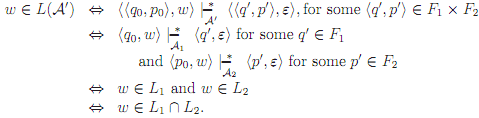
Proof (sketch): Suppose L1 and L2 are recognizable. Then there are DFAs A1 = (Q,Σ, T1, q0, F1) and A2 = (P,Σ, T2, p0, F2) such that L1 = L(A1) and L2 = L(A2). We construct A′ such that L(A′ ) = L1 ∩ L2. The idea is to have A′ run A1 and A2 in parallel-keeping track of the state of both machines. It will accept a string, then, iff both machines reach an accepting state on that string.

Let A′ = (Q × P,Σ, T′ , (q0, p0), F1 × F2), where

T′ def= [{((q, pi, (q′, p′), σ) | (q, q′, σi)∈ T1 and (p, p′, σ ∈ T2}.

2294_Class of recognizable languages.png

Then

(You should prove this; it is an easy induction on the structure of w.) It follows then that
751_Class of recognizable languages1.png


Related Discussions:- Class of recognizable languages

Universality problem, The Universality Problem is the dual of the emptiness...

The Universality Problem is the dual of the emptiness problem: is L(A) = Σ∗? It can be solved by minor variations of any one of the algorithms for Emptiness or (with a little le

Grammer, write grammer to produce all mathematical expressions in c.

write grammer to produce all mathematical expressions in c.

Deterministic finite automata, conversion from nfa to dfa 0 | 1 ____...

conversion from nfa to dfa 0 | 1 ___________________ p |{q,s}|{q} *q|{r} |{q,r} r |(s) |{p} *s|null |{p}

Transition graph for the automaton, Lemma 1 A string w ∈ Σ* is accepted by ...

Lemma 1 A string w ∈ Σ* is accepted by an LTk automaton iff w is the concatenation of the symbols labeling the edges of a path through the LTk transition graph of A from h?, ∅i to

Reducibility among problems, A common approach in solving problems is to tr...

A common approach in solving problems is to transform them to different problems, solve the new ones, and derive the solutions for the original problems from those for the new ones

Instantaneous description - recognizable language, De?nition (Instantaneous...

De?nition (Instantaneous Description) (for both DFAs and NFAs) An instantaneous description of A = (Q,Σ, δ, q 0 , F) , either a DFA or an NFA, is a pair h q ,w i ∈ Q×Σ*, where

Venkatesh, What is the arbwnememmsmdbdbfbfjmfksmjejfnfnfnnrndmnfjfjfnrnkrkf...

What is the arbwnememmsmdbdbfbfjmfksmjejfnfnfnnrndmnfjfjfnrnkrkfjfnfmkrjrbfbbfjfnfjruhrvrjkgktithhrbenfkiffnbr ki rnrjjdjrnrk bd n FBC..jcb?????????????????????????????????????????

Transition and path functions, When an FSA is deterministic the set of trip...

When an FSA is deterministic the set of triples encoding its edges represents a relation that is functional in its ?rst and third components: for every q and σ there is exactly one

Kleene Closure, 1. Does above all''s properties can be used to prove a lang...

1. Does above all''s properties can be used to prove a language regular? 2..which of the properties can be used to prove a language regular and which of these not? 3..Identify one

Write Your Message!

Captcha
Free Assignment Quote

Assured A++ Grade

Get guaranteed satisfaction & time on delivery in every assignment order you paid with us! We ensure premium quality solution document along with free turntin report!

All rights reserved! Copyrights ©2019-2020 ExpertsMind IT Educational Pvt Ltd