What are factor trees explain, Mathematics

Assignment Help:

What are Factor Trees explain?

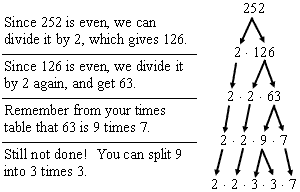
In algebra, we often need to factor a number into its prime factors. One way to do this is to use a factor tree. This is a network of numbers, starting with one number at the top of the tree, with factors branching downward from it. At each stage, each factor is broken down into smaller factors until only the prime factors are left.
1010_factorization.png

Example: Write the prime factorization of 252.

See if you can write the prime factorization of 150.

When using a factor tree, it doesn't matter which two factors you use to begin. For example, when you did your factor tree for 150, you may have chosen to start with the factors 2 and 75 or the factors 3 and 50. Trees for the prime factorization of 150 may look different, but the prime factors come out the same.

Traditionally, the factors in a prime factorization are written in numerical order (smallest to largest).

Also, exponential form may be used to emphasize how many times a prime factor appears in a prime factorization.
So, the prime factorization of 150 is 2 x 3 x 5 x 5 or 2 x 3 x 52.

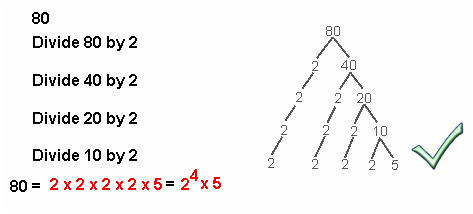
There is a more systematic way to find the prime factors of a composite number. The idea is to consistently divide the original number and then the result of each division by the smallest possible prime number until only a prime number remains.

One advantage to this method is that the prime factors automatically appear in numerical order.
Here is one example.

To find the prime factorization of the number 80:
48_Factor trees.png


Related Discussions:- What are factor trees explain

Solve the subsequent proportion, Solve the subsequent proportion: Exa...

Solve the subsequent proportion: Example: Solve the subsequent proportion for x. Solution: 5:x = 4:15 The product of the extremes is (5)(15) = 75. The produ

Geometric applications to the cross product, Geometric Applications to the ...

Geometric Applications to the Cross Product There are a so many geometric applications to the cross product also.  Assume we have three vectors a → , b → and c → and we make

Find out the probability, A speaks truth in 80% of the cases and B speaks t...

A speaks truth in 80% of the cases and B speaks truth in 60% of the cases.  Find out the probability of the cases of which they are possible to contradict each other in stating sim

Projections - vector, Projections The good way to understand projection...

Projections The good way to understand projections is to see a couple of diagrams. Thus, given two vectors a → and b → we want to find out the projection of b → onto a → . T

Geometry help, A painter leans a 10-foot ladder against the house she is to...

A painter leans a 10-foot ladder against the house she is to paint. The foot of the ladder is 3 feet from the house. How far above the ground does the ladder touch the house? Appro

What is the conditional probability based on die questions, A die is rolled...

A die is rolled twice and the sum of the numbers appearing on them is observed to be 7.What is the conditional probability that the number 2 has appeared at least once? A) 1/3

Ratio, how to do them?

how to do them?

Vectors, apllication in business and economics

apllication in business and economics

Circle, #question when equation of tangent T=0 and why

#question when equation of tangent T=0 and why

Determine the property of partial ordered relation, Determine the property ...

Determine the property of Partial ordered relation Question: Partial ordered relation is transitive, reflexive and  Answer: antisymmetric

Write Your Message!

Captcha
Free Assignment Quote

Assured A++ Grade

Get guaranteed satisfaction & time on delivery in every assignment order you paid with us! We ensure premium quality solution document along with free turntin report!

All rights reserved! Copyrights ©2019-2020 ExpertsMind IT Educational Pvt Ltd