Size - picture clause, COBOL Programming

Assignment Help:

Size:

The number of characters or digits needed to store the data item in the memory in termed as the Size of the data item.

All the 4 general characteristics explained can be specified through a PICTURE clause. The clause PICTURE is to be followed by a picture character string as shown below.
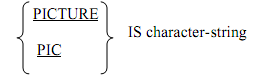
663_Size.png

The character string can contain 1 to 30 code characters which define the above mentioned attributes of the elementary item. The code characters and meaning are shown below:
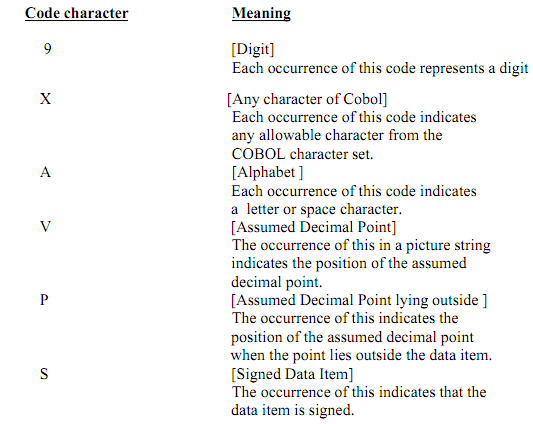
701_Size1.png

There is no exceptional code to indicate the size.

The total number of occurrence of 9, X or A in the picture string specifies the size.

The occurrence of V, P & S are not counted in determining the size of an item.

The permissible combinations are governed by the rules as shown below:

(i)  In the case of an alphabetic item the picture may hold only the symbol A.

(ii)  In the case of a numeric item the picture may hold only the symbols 9, V, P & S.

These are known as operational characters. It should hold at least one 9. 

The symbols V and S can appear only once and S, if it is involved, should be the leftmost character of the picture string. The symbol P can be repetitive on the right or on left as many times as is needed to indicate the position of the assumed decimal point.

(iii) In the case of an alphanumeric item, the picture may hold all Xs or the combination of 9, A and X (except all 9 or all A). In the afterward case the item is considered as if the string holds of all Xs.

The picture clause is only to be specified for the elementary items; it cannot be used for a group item. 

The size of a group item is equivalent to the total of the sizes of all the subordinate elementary items. The group item class is alphanumeric. 


Related Discussions:- Size - picture clause

Procedure division statements for the relative files, PROCEDURE DIVISION st...

PROCEDURE DIVISION statements for the relative files: The statements OPEN, CLOSE, READ, WRITE and REWRITE that are available for sequential files are also available for the re

Value clause - cobol programming, VALUE CLAUSE: The value clause defin...

VALUE CLAUSE: The value clause defines the preliminary value of the data item. Normally initialization will be completed just before the first statement in the procedure di

Comparison of nonnumeric operands - relational condition, Comparison of Non...

Comparison of Nonnumeric Operands: A nonnumeric operand can be compared to the other nonnumeric operand according to the rules as shown below: (i) Fields of Equal Sizes:

Program for multiply verb, PROGRAM FOR MULTIPLY VERB: We have to write...

PROGRAM FOR MULTIPLY VERB: We have to write a simple program to elaborate MULTIPLY verb. You can also use the edit characters in the program. Identification division. Pr

Filler clause - cobol programming, FILLER CLAUSE: Consider the stateme...

FILLER CLAUSE: Consider the statements as shown below: 1)  01    f    pic     x(80)  value    all "-". This statement origins a line of 80 characters filled with "-"

Different data types available in cobol, Data types available in COBOL are ...

Data types available in COBOL are given below Alpha-numeric (X), numeric (9), alphabetic (A)

File status clause, FILE STATUS clause: This clause has been involved ...

FILE STATUS clause: This clause has been involved in the above syntax for completeness. The ORGANIZATION, REVERSE, ACCESS and STATUS clause can be specified in any order.

Period or decimal point - edit characters for numeric data, .(Period or Dec...

.(Period or Decimal Point) : The period may be used to insert a decimal point and may not come into view more than once. Both the period and V cannot appear in similar picture

Occurs clause - program, OCCURS CLAUSE - PROGRAM: We have to write a p...

OCCURS CLAUSE - PROGRAM: We have to write a program to demonstrate the occurs clause. Get names of the students and show them on the screen.  identification division.

Relational condition - cobol programming, RELATIONAL CONDITION:   We ...

RELATIONAL CONDITION:   We know that a relational condition specifies a comparison between two operands and has the form.     Operand-1    relational-operator   operand-2

Write Your Message!

Captcha
Free Assignment Quote

Assured A++ Grade

Get guaranteed satisfaction & time on delivery in every assignment order you paid with us! We ensure premium quality solution document along with free turntin report!

All rights reserved! Copyrights ©2019-2020 ExpertsMind IT Educational Pvt Ltd