Rotation about the origin - 2-d and 3-d transformations, Computer Graphics

Assignment Help:

Rotation about the origin - 2-d and 3-d transformations

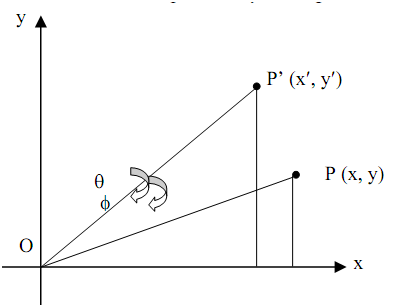
Specified a 2-D point P(x,y), which we need to rotate, along with respect to the origin O. The vector OP has a length 'r' and making a +ive or anticlockwise angle φ with respect to x-axis.

 Suppose P' (x'y') be the outcome of rotation of point P by an angle θ regarding the origin that is demonstrated in Figure 3.
1337_Rotation about the origin - 2-d and 3-d transformations.png

P(x,y) = P(r.cos φ,r.sin φ)

P'(x',y')=P[r.cos(φ+ θ),rsin(φ+ θ)]

The coordinates of P' are as:

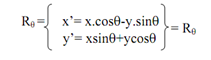
x'=r.cos(θ+ φ)=r(cos θ cos φ -sin θ sin φ)

=x.cos θ -y.sin θ     (where x=rcosφ and y=rsinφ)

As like;

y'= rsin(θ+ φ)=r(sinθ cosφ + cosθ.sinφ)

=xsinθ+ycosθ

Hence,
1628_Rotation about the origin - 2-d and 3-d transformations 1.png

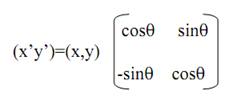
Hence, we have acquired the new coordinate of point P after the rotation. Within matrix form, the transformation relation among P' and P is specified by:
346_Rotation about the origin - 2-d and 3-d transformations 2.png

There is P'=P.Rq                                               ---------(5)

Here P'and P represents object points in 2-Dimentional Euclidean system and Rq is transformation matrix for anti-clockwise Rotation.

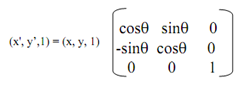
In terms of Homogeneous Coordinates system, equation (5) becomes as
2409_Rotation about the origin - 2-d and 3-d transformations 3.png

There is P'h=Ph.Rq,                                                     ---------(7)

Here P'h and Ph   represent object points, after and before needed transformation, in Homogeneous Coordinates and Rq is termed as homogeneous transformation matrix for anticlockwise  or =ive Rotation. Hence, P'h, the new coordinates of a transformed object, can be determined by multiplying previous object coordinate matrix, Ph, along with the transformation matrix for Rotation Rq.

Keep in mind that for clockwise rotation we have to put q = -q, hence the rotation matrix Rq , in Homogeneous Coordinates system, becomes:
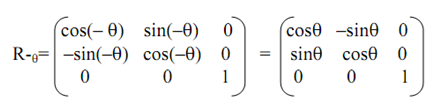
1007_Rotation about the origin - 2-d and 3-d transformations 4.png


Related Discussions:- Rotation about the origin - 2-d and 3-d transformations

Ray tracing algorithm - recursive, Ray Tracing Algorithm - Recursive ...

Ray Tracing Algorithm - Recursive Frequently, the basic ray tracing algorithm is termed as a "recursive" acquiring an outcome wherein a given process repeats itself an arbitr

Multimedia, Multimedia- It is a new aspect of literacy which is being recog...

Multimedia- It is a new aspect of literacy which is being recognized as technology expands the manner people communicate. The principle of literacy increasingly, is a measure of th

Raster scan display device - types of refresh monitors, Raster Scan Display...

Raster Scan Display Device - types of refresh monitors Now day screen display is also based on Cathode ray Tube technology, except that in place of displaying the picture tra

Graphics image processing-image processing, Graphics Image Processing: The...

Graphics Image Processing: The most generally utilized software is: Photoshop. Characteristics: I.          Most general image processing software. II.         Focuses upon

Cel animation - computer animation, Cel Animation - Computer Animation ...

Cel Animation - Computer Animation Making an animation by using this method, all characters are drawn on a separate piece of transparent paper. Also a background is drawn on a

Flat panel displays - hardware primitives, Flat Panel Displays - Hardware P...

Flat Panel Displays - Hardware Primitives 1.  Flat panel displays have now become more common. These include liquid crystal displays (LCD) and thin film electroluminescent disp

What are the important applications of computer graphics, Can you list at l...

Can you list at least three important applications of computer graphics? There are lots of interesting applications of computer graphics. Three common applications are compute

Homogeneous coordinate systems - 2-d and 3-d transformations, Homogeneous C...

Homogeneous Coordinate Systems - 2-d and 3-d transformations Suppose P(x,y) be any point in 2-D Euclidean (Cartesian) system. In HC System, we add a third coordinate to a poin

What do you understand by the term contone, Question : (a) What do you...

Question : (a) What do you understand by the term ‘contone'? (b) What are spot colours? (c) You have been asked to prepare an artwork (a magazine) to send to a printer.

Write Your Message!

Captcha
Free Assignment Quote

Assured A++ Grade

Get guaranteed satisfaction & time on delivery in every assignment order you paid with us! We ensure premium quality solution document along with free turntin report!

All rights reserved! Copyrights ©2019-2020 ExpertsMind IT Educational Pvt Ltd