Limits, Mathematics

Assignment Help:

Limits

The concept of a limit is fundamental in calculus. Often, we are interested to know the behavior of f(x) as the independent variable x approaches some particular point 'a'. The question is, if we give values to x which are nearer and nearer to 'a', will the values of f(x) come nearer and nearer to any particular value? Suppose we define a function f(x) as:

                            f(x) = 2x

It can be seen that as we give values to x which are nearer and nearer to 0, then the value of f(x) also comes nearer and nearer to 0.

If x approaches a value 'a', f(x) approaches some number L, then we say that the limit of f(x) approaches L. This is symbolically written as

1669_limit.png        is to be read as 'x approaches a'.

Sometimes we may allow x to take values which are larger and larger, without any limit. This is symbolically written as  1954_limit1.png (read as 'x approaches infinity'). If f(x) approaches a limit L as  1967_limit2.png , then we write

1129_limit3.png

In some cases, it may so happen that as x approaches a value, the value of the function f(x) may become larger and larger without any limit. This is symbolically written as:

21_limit4.png

Example 

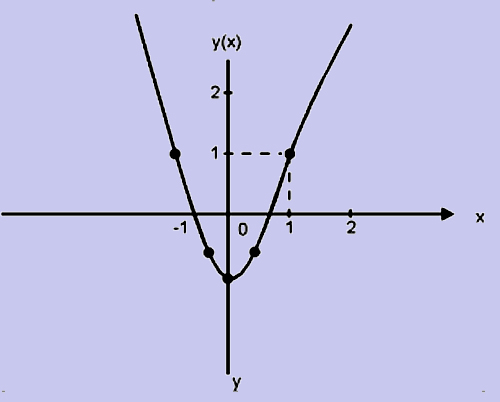
Suppose f(x) = 2x2 - 1

As x approaches value 1, f(x) approaches the value 1,

739_limit5.png

This is graphically represented below.

Figure 
1862_limit6.png


Related Discussions:- Limits

Binormal vector - three dimensional space, Binormal Vector - Three Dimensio...

Binormal Vector - Three Dimensional Space Next, is the binormal vector.  The binormal vector is illustrated to be, B → (t) = T → (t) * N → (t) Since the binormal vecto

Xy Algebra, Find the values of x and y

Find the values of x and y

Progressions, * 2^(1/2)*4^(1/8)*8^(1/16)*16^(1/32) =

* 2^(1/2)*4^(1/8)*8^(1/16)*16^(1/32) =

Geometric mean-geometric progression, Geometric mean - It is a measure ...

Geometric mean - It is a measure of central tendency normally utilized to measure industrial increases rates. - It is explained as the nth root of the product of 'n' observa

Binary, how to divide a binaries

how to divide a binaries

Properties of cross product - vector, Properties of Cross product If u,...

Properties of Cross product If u, v and w are vectors and c is a number then u → * v → = -v → * w →                                                       (cu → ) * v → =

Monotonic, Monotonic, Upper bound and lower bound Given any sequence {a...

Monotonic, Upper bound and lower bound Given any sequence {a n } we have the following terminology: 1.   We call or denote the sequence increasing if a n n+1 for every n.

Solve by factorization, Solve by factorization X 2 +(a/a+b + a+b/a)x+...

Solve by factorization X 2 +(a/a+b + a+b/a)x+1 = 0 X 2 +(a/a+b + a+b/a)x+1 =>  X 2 +(a/a+b x a+b/ax + a/a+b .a+b/a) =>  X[x+a/a+b] +a+b/a[a+a*a+b]= 0 =>  X= -a

Function expansion, The functions {sinmx; cosmx}; m = 0,....∞ form a ...

The functions {sinmx; cosmx}; m = 0,....∞ form a complete set over the interval x ∈ [ -Π, Π]. That is, any function f(x) can be expressed as a linear superposition of these

Write Your Message!

Captcha
Free Assignment Quote

Assured A++ Grade

Get guaranteed satisfaction & time on delivery in every assignment order you paid with us! We ensure premium quality solution document along with free turntin report!

All rights reserved! Copyrights ©2019-2020 ExpertsMind IT Educational Pvt Ltd