How exceptions propagate in pl/sql programming?, PL-SQL Programming

Assignment Help:

How Exceptions Propagate ?

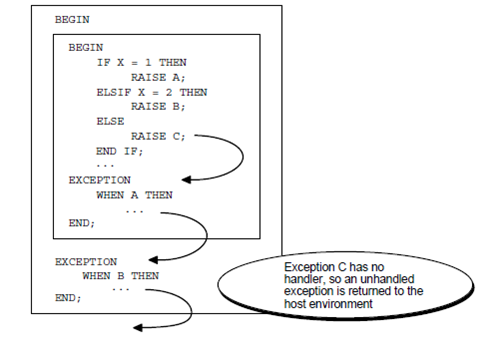
Whenever an exception is raised, and if the PL/SQL cannot find a handler for it in the present subprogram or block, the exception propagates. That is, the exceptions reproduce it in the succeeding enclosing blocks until a handler is found or there are no more blocks to search. In the latter situation, the PL/SQL returns an unhandled exception error to the host atmosphere.

Though, exceptions cannot propagate across the remote procedure calls (RPCs). As a result, the PL/SQL block cannot catch an exception raised by a remote subprogram.
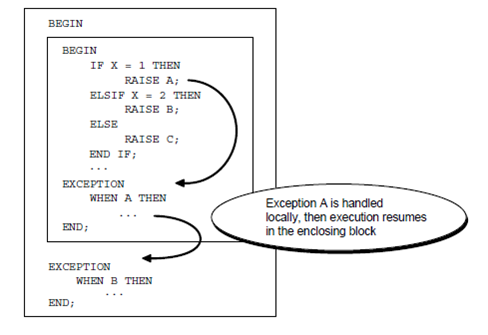
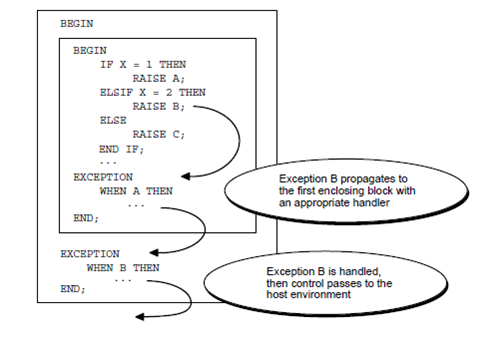
1751_exceptions propogate.png


581_exceptions propogate1.png


2358_exceptions propogate2.png

An exception can propagate additional than its scope, that is, additional than the block in which it was declared. Consider the illustration which is as shown below:

BEGIN

...

DECLARE ---------- sub-block begins

past_due EXCEPTION;

BEGIN

...

IF ... THEN

RAISE past_due;

END IF;

END; ------------- sub-block ends

EXCEPTION

...

WHEN OTHERS THEN

ROLLBACK;

END;

As the block in which the exception past_due was declared has no handler, the exception propagates to the enclosing block. But, according to the scope rules, the enclosing blocks cannot reference the exceptions declared in a sub-block. Therefore, only an OTHERS handler can catch the exception.


Related Discussions:- How exceptions propagate in pl/sql programming?

Operator precedence-pl/sql expressions , Operator Precedence The operati...

Operator Precedence The operations within an expression are completed in a particular order depending on their precedence (priority). The table shows the default order of the op

Cursors in pl/sql, Cursors The Oracle uses work areas to execute the SQ...

Cursors The Oracle uses work areas to execute the SQL statements and to store process information. A PL/SQL construct known as the cursor. Let's you assume name a work area and

When are constraints checked - sql, When Are Constraints Checked Unde...

When Are Constraints Checked Under the model constraints are conceptually checked at all statement boundaries (and only at statement boundaries). By default the same is true

Keyword and parameter description in pl sql, Keyword and Parameter Descript...

Keyword and Parameter Description: label_name: This is an undeclared identifier which optionally labels the PL/SQL block. When used, label_name should be enclosed by the do

Update command- sql, UPDATE Command- SQL Loosely speaking, UPDATE chan...

UPDATE Command- SQL Loosely speaking, UPDATE changes some of the column values of some existing rows of its target table. Thus, although some rows disappear from the target an

Creating a table, Creating a Table Syantax: CREATE TABLE ENROL...

Creating a Table Syantax: CREATE TABLE ENROLMENT (StudentId SID, Name   VARCHAR (30) NOT NULL, CourseId CID, PRIMARY KEY (StudentId, CourseId)) ; Explan

Fetch statement - syntax, FETCH Statement The FETCH statement retrieve ...

FETCH Statement The FETCH statement retrieve rows of data one at a time from the result set of the multi-row query. The data is stored in fields or variables which correspond t

Selecting objects in pl sql, Selecting Objects: Suppose that you have ...

Selecting Objects: Suppose that you have run the SQL*Plus script below that creates object type Person and object table persons, and that you have settled the table: CREATE

Mixed notation, Mixed Notation The fourth procedure call shows that yo...

Mixed Notation The fourth procedure call shows that you can mix the positional and named notation. In this situation, the first parameter uses the positional notation, & the s

Write Your Message!

Captcha
Free Assignment Quote

Assured A++ Grade

Get guaranteed satisfaction & time on delivery in every assignment order you paid with us! We ensure premium quality solution document along with free turntin report!

All rights reserved! Copyrights ©2019-2020 ExpertsMind IT Educational Pvt Ltd