Block structure in pl/sql, PL-SQL Programming

Assignment Help:

Block Structure

The PL/SQL is a block-structured language. That is, the fundamental units (procedures, anonymous blocks, and functions) that make up a PL/SQL program are logical blocks that can contain any number of nested sub-blocks. Usually, each logical block corresponds to a problem or sub problem to be solved. Hence, PL/SQL supports the divide-and-conquer approach to problem solving known as the stepwise refinement.

A block or sub-block, lets you group logically related to declarations and statements. That way, you can place the declarations close to where they are used. These declarations are local to the block and cease to be present when the block completes.

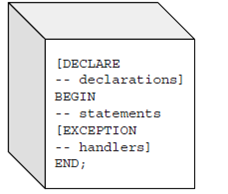
As the figure shows, a PL/SQL block has three sections: a declarative section, an executable section, and an exception-handling section. (In PL/SQL, a warning or error condition is termed as an exception.) Only the executable section is needed.

The order of the section is logical. First comes the declarative section, in which items can be declared. Once the items are declared, it can be manipulated in the executable section. The Exceptions raised during an execution can be dealt within the exception-handling section.
 

106_block structure.png

Figure: Block Structure

You can nest sub-blocks in the executable and exception-handling sections of a PL/SQL block or subprogram but not in the declarative part. You can also define local subprograms in the declarative section of any block. Though, you can call local subprograms only from the block in which they are defined.


Related Discussions:- Block structure in pl/sql

Initializing and referencing collections, Initializing and Referencing Coll...

Initializing and Referencing Collections Until you initialize a collection, a nested table or varray is automatically null (i.e. the collection itself is null, not its elements)

Transaction control, Transaction Control The Oracle is transaction orie...

Transaction Control The Oracle is transaction oriented; that is, Oracle uses the transactions to make sure the data integrity. The transaction is a sequence of SQL data manip

Entering and exiting - autonomous transaction, Entering and Exiting If...

Entering and Exiting If you enter the executable part of an autonomous routine, the major transaction suspends. When you exit the routine, the major transaction resumes. To ex

I want database development with analysis tools, Project Description: I ...

Project Description: I want a database for large governmental and private data sets on one country that will be easily extended to other countries in the future. Also, the datab

Using set transaction, Using SET TRANSACTION You use the SET TRANSACTI...

Using SET TRANSACTION You use the SET TRANSACTION statement to begin the read-only or read-write transaction, start an isolation level, or assign your present transaction to a

Update stock levels, At times, customers make mistakes in submitting their ...

At times, customers make mistakes in submitting their orders and call to cancel the order. Brewbean's wants to create a trigger that automatically updates the stock level of all pr

Data types in sql - decimal, Data Types in SQL - Decimal DECIMAL, NUME...

Data Types in SQL - Decimal DECIMAL, NUMERIC, REAL, FLOAT and various other terms for various sets of rational numbers. When these key words are specified for the declared typ

Oracle 11 g new features , Oracle 11 G new features associated with this re...

Oracle 11 G new features associated with this release:- Enhanced ILM  - Information Lifecycle Management (ILM) has been around for the almost 10 years, but Oracle has made

Scoping-naming conventions, Scoping Within the similar scope, all the de...

Scoping Within the similar scope, all the declared identifiers should be unique. So, even if their datatypes differ, the variables and parameters cannot share the similar name.

Semijoin and composition - sql, Semijoin and Composition - SQL For sem...

Semijoin and Composition - SQL For semijoin, the dyadic relational operator MATCHING, defined thus: r1 MATCHING r2, where r1 and r2 are relations such that r1 JOIN r2 is de

Write Your Message!

Captcha
Free Assignment Quote

Assured A++ Grade

Get guaranteed satisfaction & time on delivery in every assignment order you paid with us! We ensure premium quality solution document along with free turntin report!

All rights reserved! Copyrights ©2019-2020 ExpertsMind IT Educational Pvt Ltd