Explain cell membrane and plasma membrane, Biology

Assignment Help:

Explain cell membrane?

The Cell Membrane :  The cell membrane, or plasma membrane, separates the cell from neighboring cells or from the external environment. Both prokaryotic and eukaryotic cells have cell membranes. The cell membrane is composed of two sheet-like layers of phospholipids. Phosholipids are polar molecules that have two distinctly different ends.
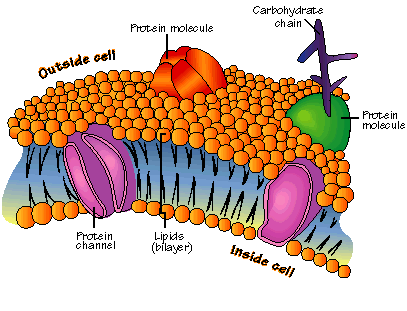
379_The Cell Membrane.png

One end of each molecule making up the sheet layer has an alcohol attached by a phosphate group. This end, or hydrophilic head (from the Greek words meaning water-loving), is water soluble, resulting in all of the polar ends pointing outward toward the water,

The other end is non-polar, or hydrophobic (from the Greek meaning water-fearing). Being non-polar, the ends of all of the molecules point away from the surrounding water rather than interact with the water. This forms a sheet-like barrier that separates the interior of the membrane from the outside environment. This sheet of molecules forms a sandwich-like structure about 7.5 to 10 nanometers thick.

In the generally-accepted fluid mosaic model, the membrane is composed of a double layer of phospholipids, in which is embedded a variety of proteins. The phospholipid bilayer is somewhat fluid, allowing movement of protein particles within it.

Movement across the cell membrane can occur through a number of different processes, including pinocytosis and phagocytosis. Substances also permeate, or pass through, the cell membrane by diffusion, osmosis, active transport and passive transport.


Related Discussions:- Explain cell membrane and plasma membrane

Aerobic cellular respiration during muscle exercise, Q. What happens when t...

Q. What happens when the oxygen supply is inadequate to maintain aerobic cellular respiration during muscle exercise? If oxygen from myoglobin or hemoglobin is not enough for t

Define the starch gel electrophoresis, Define the Starch gel electrophoresi...

Define the Starch gel electrophoresis? Starch gel has the advantage of fine texture and absence of protein adsorption with a molecular sieving effect retarding proteins of larg

What is the difference between venous and arterial blood, Q. What is the di...

Q. What is the difference between venous and arterial blood? Arterial blood is the oxygen-rich and carbon dioxide-poor blood that irrigates the tissues. Venous blood is the oxy

Which kind of plant tissue is cork, Which kind of plant tissue is cork? ...

Which kind of plant tissue is cork? The Cork is the material for instance, used to cap wine bottles, and is extracted from the suber of a special oak called cork.

What are the vascular bundles, What are the vascular bundles? How does conf...

What are the vascular bundles? How does configuration of the vascular bundles within the stem differentiate monocots from dicots? The Vascular bundles are segments of xylem and

Lipids, How are lipids classified?

How are lipids classified?

Geology LAB, Can you guys help with my homework assignment for Geology?

Can you guys help with my homework assignment for Geology?

What characteristics of fatty acids are false, What characteristics of fatt...

What characteristics of fatty acids are false? (Dissolves in water, used for energy storage, used to build lipids, found in triglycerides, found in steroids)?

Define mobilization of bone calcium and phosphorous, Define Mobilization of...

Define Mobilization of bone calcium and phosphorous? It is now firmly established that vitamin D 3 is metabloized first in the liver to 25-hydroxyvitamin D (25 OH- D) (calcicl

Write Your Message!

Captcha
Free Assignment Quote

Assured A++ Grade

Get guaranteed satisfaction & time on delivery in every assignment order you paid with us! We ensure premium quality solution document along with free turntin report!

All rights reserved! Copyrights ©2019-2020 ExpertsMind IT Educational Pvt Ltd