Explain balanced wye-connected load, Electrical Engineering

Assignment Help:

Balanced Wye-Connected Load

Let us consider a three-phase, four-wire 208-V supply system connected to a balanced wye connected load with an impedance of 10 20° , as shown in Figure (a). We shall solve for the line currents and draw the corresponding phasor diagram.

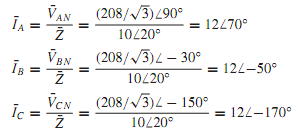
Conventionally it is assumed that 208 V is the rms value of the line-to-line voltage of the supply system, and the phase sequence is positive, or A-B-C, unless mentioned otherwise. The magnitude of the line-to-neutral (or phase) voltages is given by 208/√3, or 120 V. Selecting the line currents returning through the neutral conductor, as shown in Figure, we have
1407_Balanced Wye-Connected Load.png

Note that ¯VBC has been chosen arbitrarily as the reference phasor, as in Figure (b). Assuming the direction of the neutral current toward the load as positive, we obtain

1532_Balanced Wye-Connected Load1.png

That is to say that the system neutral and the star point of the wye-connected load are at the same potential, even if they are not connected together electrically. It makes no difference whether they are interconnected or not.

Thus, for a balanced wye-connected load, the neutral current is always zero. The line currents and phase currents are equal inmagnitude, and the line currents are in phasewith the corresponding phase currents. The line-to-line voltages, in magnitude, are √3 times the phase voltages, and the phase voltages lag the corresponding line voltages by 30°.

The phasor diagram is drawn in Figure(b), from which it can be observed that the balanced line (or phase) currents lag the corresponding line-to-neutral voltages by the impedance
55_Balanced Wye-Connected Load2.png

angle (20° in our example). The load power factor is given by cos 20° for our problem, and it is said to be lagging in this case, as the impedance angle is positive and the phase current lags the corresponding phase voltage by that angle.

The problem can also be solved in a simpler way by making use of a single-line equivalent circuit, as shown in Figure(c),

303_Balanced Wye-Connected Load3.png

in which ¯ VL-N is chosen as the reference for convenience. The magnitude of the line current and the power factor angle are known; the negative sign associated with the angle indicates that the power factor is lagging. By knowing that the line (or phase) currents ¯IA, ¯IB, ¯IC lag their respective voltages ¯VAN, ¯VBN, and ¯VCN by 20°, the phase angles of various voltages and currents, if desired, can be obtained with respect to any chosen reference, such as ¯VBC.


Related Discussions:- Explain balanced wye-connected load

Ideal or perfect transformer, a) A 230 V/25V, 50 HZ transformer with a rate...

a) A 230 V/25V, 50 HZ transformer with a rated primary current of 1,2 Amps is used to supply a number of 25 V, 30 Watt halogen light bulbs. Assuming an ideal transformer and tha

RC phase shift oscillator, For the RC phase-shift oscillator if c=1pF and R...

For the RC phase-shift oscillator if c=1pF and R=10K determine the value of Rf

Semiconductors, Why do potential barriers breaks when a breakdown voltage i...

Why do potential barriers breaks when a breakdown voltage is application to semiconductor

Electronic photo flash, Q. Electronic Photo Flash? A simplified schemat...

Q. Electronic Photo Flash? A simplified schematic diagram of the electric circuit of an electronic photo flash typically used on cameras is shown in Figure 7.7.1. By passing a

Design the low-pass filter, Q. Design the low-pass filter shown in Figure (...

Q. Design the low-pass filter shown in Figure (by determining L) to have a half-power frequency of 10 kHz.

Sketch the phasor diagram of the voltage, Q. The line-to-line voltage of a ...

Q. The line-to-line voltage of a balanced wye connected three-phase source is given as 100 V. Choose V AB as the reference. (a) For the phase sequence A-B-C, sketch the phasor

Meters and measurements, The subject of electrical measurements is such a l...

The subject of electrical measurements is such a large one that entire books have been written on the topic. Only a few basic principles will be introduced here. Practical measurem

Describe the basic types of number systems, Q. Describe the basic types of ...

Q. Describe the basic types of Number Systems? Probably the largest stumbling block most beginning programmers encounter when attempting to learn assembly language is the commo

Write Your Message!

Captcha
Free Assignment Quote

Assured A++ Grade

Get guaranteed satisfaction & time on delivery in every assignment order you paid with us! We ensure premium quality solution document along with free turntin report!

All rights reserved! Copyrights ©2019-2020 ExpertsMind IT Educational Pvt Ltd