Direct and indirect semiconductors, Electrical Engineering

Assignment Help:

Direct and Indirect Semiconductors

1) In a common quantitative calculation of band structures, the wave function of a single electron traveling by a perfectly periodic lattice is assumed to be in the type of a plane wave moving in the x-direction (say) with propagation constant k, as well called a wave vector.

2) In quantum mechanics, the electron momentum can be provided by p= hk.

3) The wave function that is space dependent for the electron is ΨK (X) = U (Kx,x) ejK,x  in which the function U(Kx,x) modulates the wave function as per to the periodicity of the lattice.

4) Allowed values of energy, where as plotted as a function of k, gives the E-k diagram.

5) As the periodicity of most lattices is different in several directions, the E-k diagram is a complex surface that is to be visualized in three dimensions.

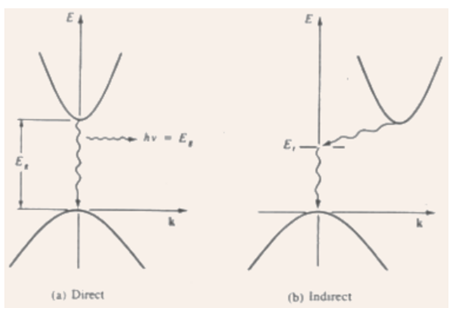
6) Direct band gap semiconductor: the minima of the conduction band and the maxima of the valence band take place at the same value of k => an electron creating the smallest energy transition from the conduction band to the valence band can do so with no a change in k (and, the momentum).
1968_Direct and Indirect Semiconductors.png

Figure:  Direct and indirect transition of electrons from the conduction band to the valence band:  (a) direct - with accompanying photon emission, (b) indirect via defect level.  

7) Indirect band gap semiconductor: the minima of the conduction band and the maxima of the valence band take place for different values of k, so, the smallest energy transition for an electron needs a change in momentum.

8) Electron  that falling  from  conduction  band  to  an  empty  state  in  valence  band => recombination.

9) Recombination possibility for direct band gap semiconductors is much higher than as compared to that for indirect band gap semiconductors.

10) Direct band gap semiconductors give up the energy released throughout this transition (=Eg) in the form of light => employed for optoelectronic applications (e.g., LEDs and LASERs).

11) Recombination in indirect band gap semiconductors takes place by some defect states within the band gap, and the energy is released in the type of heat given to the lattice.


Related Discussions:- Direct and indirect semiconductors

Common source amplifier, Common Source Amplifier A common-source ampl...

Common Source Amplifier A common-source amplifier is one of three basic single-stage field-effect transistor abbreviated as FET amplifier topologies, commonly used as a volta

C R O DELAY LINE, WHAT IS THE FUNCTION OF DELAY LINE IN CRO

WHAT IS THE FUNCTION OF DELAY LINE IN CRO

Evaluate the diode current id, Question: (a) The piecewise linear appro...

Question: (a) The piecewise linear approximation given in Figure is assumed for the diode in the circuit shown in Figure. Evaluate the diode current ID. (b) The piecew

Digital control system, block diagram of digital control system and explain...

block diagram of digital control system and explain each block

Effective value for periodic waveforms, Q. With a direct current of I A, th...

Q. With a direct current of I A, the power expended as heat in a resistor of Ris constant, independent of time, and equal to I 2 R. Consider Problem and find in each case the effe

General purpose registers, General  Purpose  Registers Registers B, C...

General  Purpose  Registers Registers B, C ,D, E H , and L   are 8 bit  general  purpose  registers. These  registers store  8 bit  data  temporarily  for processing. Some

Microprocessors, three application of microprocessor

three application of microprocessor

Squeeze castings, Squeeze Castings: Squeeze casting, also known as ...

Squeeze Castings: Squeeze casting, also known as liquid metal forging, is a combination of casting and forging process . The molten metal is poured into the bottom half

Mention the categories of instruction, Mention the categories of instructio...

Mention the categories of instruction and give two examples for each category The instructions of 8085 can be categorized into the following five Data transfer MOV Rd,Rs

Find the ratio of amplifier gain, The input to the satellite system of Figu...

The input to the satellite system of Figure 1 is a step function θ c (t) = 5u(t) in degrees. As a result, the satellite angle θ(t) varies sinusoidally at a frequency of 10 cycles p

Write Your Message!

Captcha
Free Assignment Quote

Assured A++ Grade

Get guaranteed satisfaction & time on delivery in every assignment order you paid with us! We ensure premium quality solution document along with free turntin report!

All rights reserved! Copyrights ©2019-2020 ExpertsMind IT Educational Pvt Ltd