Depth first search, Data Structure & Algorithms

Assignment Help:

DEPTH FIRST SEARCH (DFS)

The approach adopted into depth first search is to search deeper whenever possible. This algorithm frequently searches deeper through visiting unvisited vertices and whenever an unvisited vertex is not determined, it backtracks to earlier vertex to find out whether there are yet unvisited vertices.

As seen, the search described above is inherently recursive. We can determine a very simple recursive process to visit the vertices within a depth first search. The DFS is more or less alike to pre-order tree traversal. The procedure can be described as below:

Begun from any vertex (source) in the graph and mark it visited. Determine vertex that is adjacent to the source and not earlier visited via adjacency matrix & mark it visited. Repeat this procedure for all vertices that is not visited, if vertex is determined visited in this procedure, then return to the earlier step and begin the same process from there.

If returning back toward source is not possible, then DFS from the originally chosen source is complete and begin DFS using any unvisited vertex.
1686_DEPTH FIRST SEARCH.png

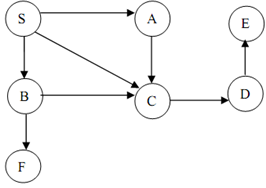
Figure: A Digraph

Let the digraph of Figure. Begun with S and mark it visited. Then visit the next vertex A, after that C & then D and finally E. Now there are no adjacent vertices of E to be visited next. Thus, now, backtrack to earlier vertex D as it also has no unvisited vertex. Now backtrack to C, then A, finally to S. Now S has an unvisited vertex B.

Begun DFS with B as a root node and then visit F. Now all of the nodes of the graph are visited.

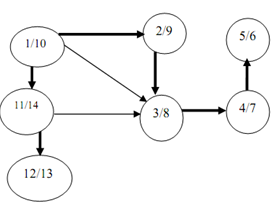
Figure shows a DFS tree with a sequence of visits. The first number mention the time at which the vertex is visited first and the second number mention the time upon which the vertex is visited throughout back tracking.
386_DEPTH FIRST SEARCH1.png

Figure: DFS tree of digraph of above figure

The DFS forest is illustrated with shaded arrow in  above Figure.


Related Discussions:- Depth first search

Best case, Best Case: If the list is sorted already then A[i] T (n) = ...

Best Case: If the list is sorted already then A[i] T (n) = c1n + c2 (n -1) + c3(n -1) + c4 (n -1)  = O (n), which indicates that the time complexity is linear. Worst Case:

What are the properties of colour, Properties of colour Colour descript...

Properties of colour Colour descriptions and specifications generally include three properties: hue; saturation and brightness. Hue associates a colour with some position in th

User-specified memory location, You need to implement a function which will...

You need to implement a function which will write out a given user-specified memory location to disk in base 10. That means that you have to convert the large number data structure

Define complete binary tree, Define Complete Binary Tree Complete Binar...

Define Complete Binary Tree Complete Binary Tree:- A whole binary tree of depth d is that strictly binary tree all of whose leaves are at level D.

Algorithm for dfs, Step 1: Choose a vertex in the graph and make it the sou...

Step 1: Choose a vertex in the graph and make it the source vertex & mark it visited. Step 2: Determine a vertex which is adjacent to the source vertex and begun a new search if

Define min-heap, Define min-heap A min-heap is a complete binary tree i...

Define min-heap A min-heap is a complete binary tree in which each element is less than or equal to its children. All the principal properties of heaps remain valid for min-hea

Deletion of any element from the circular queue, Algorithm for deletion of ...

Algorithm for deletion of any element from the circular queue: Step-1: If queue is empty then say "queue is empty" & quit; else continue Step-2: Delete the "front" element

A sort which relatively passes by a list, A Sort which relatively passes by...

A Sort which relatively passes by a list to exchange the first element with any element less than it and then repeats with a new first element is called as      Quick sort.

Infix expression into the postfix expression, Q. Convert the given infix ex...

Q. Convert the given infix expression into the postfix expression (also Show the steps) A ∗ (B + D)/ E - F(G + H / k ) Ans. Steps showing Infix to Post fix

Write Your Message!

Captcha
Free Assignment Quote

Assured A++ Grade

Get guaranteed satisfaction & time on delivery in every assignment order you paid with us! We ensure premium quality solution document along with free turntin report!

All rights reserved! Copyrights ©2019-2020 ExpertsMind IT Educational Pvt Ltd