Hashing and hash functions, Data Structure & Algorithms

Assignment Help:

Q. Describe the term hashing. Explain any two usually used hash functions. Explain one method of collision resolution.                                                                                                     

Ans.

A hash table is a data structure in which the location or address of a data item is determined directly as a function of data item itself instead of by a sequence of comparison. Under ideal condition, the time needed to find a data item in a hash table is

0(1) ie. it is constant and documents does  not depend on the number of data items stored in it.

When the set of K of keys saved is much smaller than the universe U of all the probable keys, a hash table need much less storage spare than a direct address table.

Hash Function is described as follows

A hash function h is simply a mathematical or calculative formula that manipulates the key in some form to compute or calculate the index for this key in the hash table. Eg a hash function can split the key by some number, generally the size of the hash table and return remainder as the index for the key. Commonly, we say that a hash function h maps the universe U of keys into the slots of a hash table T[0....n-1]. This process of mapping keys to appropriate slots in a hash table is called as hashing.

A hash function h is generally a mathematical or calculative formula that manipulates the key in some form to compute or calculate the index for this key in the hash table. Eg a hash function can split the key by some number, generally the size of the hash table and return remainder as the index for the key. Commonly, we say that a hash function h maps the universe U of keys into slots of a hash table T[0....n-1]. This process of mapping keys to appropriate slots in a hash table is called as hashing.

 (a) Division Method is given as follows:- In this process, key K to be mapped into one of the m states in the hash table is separated by m state in the hash table is divided by m and the remainder of this separation taken as index into the hash table. The hash function is as follows

h(k) = k mod m

where mod is the modules operations performed.

(b)    Multiplication Methodis described as: The multiplication method or technique operates in 2 steps. In the 1st step the key value K is multiplied by a constant A in the range O

h(k) = [m (K A mod 1)]

Methods of Collision Resolution are stated below

1)      Collision Resolution by the separate chaining

2)      Collision Resolution by an open addressing


1)      In this scheme all elements whose key hash to same hash table slot are put in a related list. Thus the slot in the hash table comprises a pointer to the head of the related list of all the elements that hash to value i. If there is no such element that hash to value I , the slot I comprises the NULL value ( pictures as X)
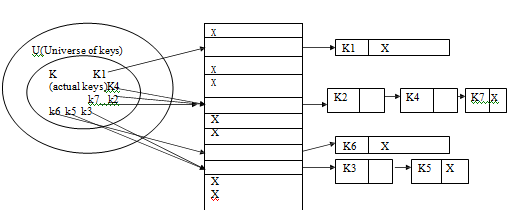
1889_collision resolution.png


Related Discussions:- Hashing and hash functions

Perform inorder, QUESTION (a) Construct a binary tree for the following...

QUESTION (a) Construct a binary tree for the following numbers assuming that a number greater than the node (starting from the root) goes to the left else it goes to the right.

Advanced data structures, In this unit, the following four advanced data st...

In this unit, the following four advanced data structures have been practically emphasized. These may be considered as alternative to a height balanced tree, i.e., AVL tree.

Pre-order and post order traversal of a binary tree, The pre-order and post...

The pre-order and post order traversal of a Binary Tree generates the same output. The tree can have maximum One node

Structures for complete undirected graphs, Q. Draw  the structures of compl...

Q. Draw  the structures of complete  undirected  graphs  on  one,  two,  three,  four  and  five vertices also prove that the number of edges in an n vertex complete graph is n(n-1

Circularly linked lists implementation, CIRCULARLY LINKED LISTS IMPLEMENTAT...

CIRCULARLY LINKED LISTS IMPLEMENTATION A linked list wherein the last element points to the first element is called as CIRCULAR linked list. The chains do not specified first o

Indexed sequential file organisation, When there is requirement to access r...

When there is requirement to access records sequentially by some key value and also to access records directly by the similar key value, the collection of records may be organized

What is bubble sort, What is bubble sort? Bubble Sort: The basic ide...

What is bubble sort? Bubble Sort: The basic idea in bubble sort is to scan the array to be sorted sequentially various times. Every pass puts the largest element in its corr

Algorithm for inorder traversals, Step-1: For the current node, verify whet...

Step-1: For the current node, verify whether it contain a left child. If it has, then go to step-2 or else go to step-3 Step-2: Repeat step-1 for left child Step-3: Visit (th

What is a container taxonomy, What is A Container Taxonomy It's useful ...

What is A Container Taxonomy It's useful to place containers in a taxonomy to help understand their relationships to one another and as a basis for implementation using a class

Write Your Message!

Captcha
Free Assignment Quote

Assured A++ Grade

Get guaranteed satisfaction & time on delivery in every assignment order you paid with us! We ensure premium quality solution document along with free turntin report!

All rights reserved! Copyrights ©2019-2020 ExpertsMind IT Educational Pvt Ltd