Reference no: EM133984248
Relevant Course Objectives:
- Apply main mathematical operations of (addition, subtraction, multiplication and division) to function.
- Find the inverse of a function.
- Form composite functions.
- Find domain and range of functions.
- Use the remainder and factor theorem.
- Find factors of a polynomial using long or synthetic division.
- Solve quadratic equations using completing the square, factorization or the quadratic formula.
- Solve logarithmic and exponential equations.
- Solve linear inequalities.
- Solve system of linear inequalities.
- Identify arithmetic and geometric sequences.
- Find the nth term of an arithmetic sequence and geometric sequence.
- Apply the knowledge of functions to problems involving supply, demand, production, revenue and cost.
- Identify the appropriate functions, equations and sequences which are to be used in problem solving in the Social Sciences.
- Use solutions to linear, quadratic, exponential and logarithmic equations to determine market equilibrium price and quantity.
Problem Set A
Question 1. Determine which of the following: Linear, Quadratic, Constant, Rational, Absolute Value or Polynomial best describes each function below.
a. f(t) = 25 - p
b. q(p) = 7p² - 4|5p - 4|
c. h(r) = (3r²/4) - t4
d. r(s) = (12s5 - 5s)/(6s7 + m)
Question 2. State whether the relation {(2,2), (-1,5), (5,2), (2,4)} is a function. Give a reason for your decision.
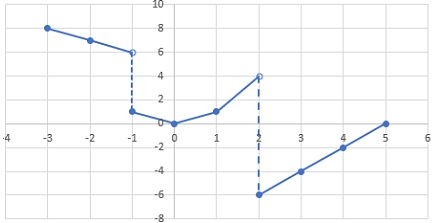
Question 3. The diagram below shows the function Q(p) drawn to scale.
Answer the following questions referring to the above diagram:
a. How many functions made up the diagram?
b. State the domain for each individual function that is drawn above.
c. Determine the value of Q(-1).
d. State the range of the function.
Question 4. Use synthetic division to determine whether (q - 3) is a factor of the polynomial q4 - 2q2 + 2.
Question 5. Given that q(p) = 6p - 3 and w(p) = 7p + p² + 12, determine:
a. h(p) = q(p) / w(p)
b. q(p - 4) = -9
c. State why p = -3 cannot be included in the domain of h(p).
Problem Set B
Question 1. Find the inverse of h(t) = -2t / (4 - 3t).
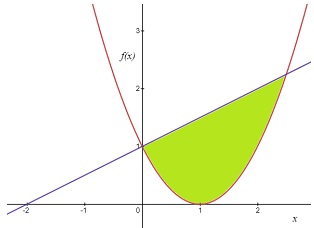
Question 2. Given the diagram below,
provide answers to the following questions:
a. Identify two points that the straight-line passes through.
b. What is the nature or type of the quadratic's roots?
c. Determine the equation of the straight-line drawn in blue.
d. Determine the function/equation of the quadratic.
e. The straight-line and quadratic intersect at two points, one point is (0,1). Determine the second point.
Question 3. Solve the inequality: 48 < -13p + p².
Problem Set C
Question 1. Solve the following:
i. e2r - 1 = 3
ii. log4(t + 3) = 3 - log5 125
Question 2. Determine the range of values for t that will satisfy the inequality (t - 2)/(t - 5) > 1. Get AI-free online assignment help by the best tutors.
Question 3. The fifth term of a GP is 16, the third term is 4 and the sum of the first ten terms is positive. Calculate:
i. First term
ii. Common difference
iii. Sum of the first ten terms
Problem Set D
Question 1. Graphically solve the system of linear inequalities:
4q ≥ 8 - 2p
p - 4 > q
p ≤ 8
Question 2. The sum of first n terms of an arithmetic progression is Sn = n(3n - 4). Determine:
i. Sum of the first four terms.
ii. Value of the fourth term.
Question 3. Solve the pair of equations:
xy = 2
x + y - 3 = 0
Problem Set E
Question 1. Express in terms of log p, log q and log r: log(pr2/q3).
Question 2. Determine whether the given points (0,2), (2,5) and (3,7) fall on the same straight-line.
Question 3. Classify the following sequence: r - 5, 5, r + 5, ...
Question 4. Make h the subject of the formula: 7/(5h2 - 2) = m.
Question 5. Given that a quadrilateral ABCD has points (3, -1), (6, 0), (7, 3) and (4, 2) respectively:
i. Identify the diagonals of the quadrilateral ABCD.
ii. Determine whether the diagonals are perpendicular.