Homogeneous coordinate systems - 2-d and 3-d transformations, Computer Graphics

Assignment Help:

Homogeneous Coordinate Systems - 2-d and 3-d transformations

Suppose P(x,y) be any point in 2-D Euclidean (Cartesian) system. In HC System, we add a third coordinate to a point. In place of (x,y), all points are represented via a triple (x,y,H) where H≠0;  along with the condition which is (x1,y1,H1)=(x2,y2,H2) ↔ x1/H1 = x2/H2 ; y1/H1 = y2/H2.

Currently, if we take H=0, then we contain point at infinity, that is, generation of horizons.

Hence, (2, 3, 6) and (4, 6, 12) are the similar points are represented by various coordinate triples, that is each point has many diverse Homogeneous Coordinate representation.

2-D Euclidian System                    Homogeneous Coordinate System

Any point (x,y)                                  (x,y,1)


If (x,y,H) be any point in HCS(such that H≠0); Then (x,y,H)=(x/H,y/H,1)

(x/H,y/H)                          (x,y,H)

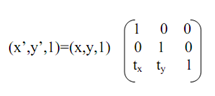
Currently, we are in the position to build the matrix form for the translation along with the utilization of homogeneous coordinates.For translation transformation (x,y)→(x+tx,y+ty) within Euclidian system, here tx and ty both are the translation factor in direction of x and y respectively. Unfortunately, this manner of illustrating translation does not utilize a matrix; consequently it cannot be combined along with other transformations by easy matrix multiplication. That type of combination would be desirable; for illustration, we have observed that rotation about an arbitrary point can be done via a rotation, a translation and the other translation. We would like to be capable to combine these three transformations in a particular transformation for the sake of elegance and efficiency. One way of doing such, is to utilize homogeneous coordinates. In homogeneous coordinates we utilize 3x3 matrices in place of 2x2, initiating an additional dummy coordinate H. In place of (x,y), each point is demonstrated by a triple (x,y,H) here H≠0; In two dimensions the value of H is generally set at 1 for simplicity.

Hence, in homogeneous coordinate systems (x,y,1) → (x+tx,y+ty,1), now, we can simplifies this in matrix form like:
1389_Homogeneous Coordinate Systems - 2-d and 3-d transformations.png


Related Discussions:- Homogeneous coordinate systems - 2-d and 3-d transformations

Target market before doing a design work, Question: (a) Explain the i...

Question: (a) Explain the importance of knowing and understanding your target market before doing a design work. Use example(s) to enhance your answer. (b) Describe the

Carry out a perspective projection, Consider the line segment AB in 3-Dimen...

Consider the line segment AB in 3-Dimentional parallel to the z-axis along with end points A (- 5,4,2) and also B (5,-6,18). Carry out a perspective projection upon the X=0 plane;

What do you mean by emissive and non-emissive displays, What do you mean by...

What do you mean by emissive and non-emissive displays? EMISSIVE: The emissive display changes electrical energy into light energy. The plasma panels, thin film ele

Vanishing point - viewing transformations, Vanishing Point - Viewing Transf...

Vanishing Point - Viewing Transformations This point is that point at those parallel lines shows to converge and vanish. A practical illustration is a long straight railroad

Scan conversion - 2d shape primitives, Scan conversion: For display of...

Scan conversion: For display of a continuously defined object, a method to map a continuous abstract object or shape into a discrete plane of computer display is needed.  This

Orthographic and oblique projection - viewing transformation, Orthographic ...

Orthographic and Oblique Projection - Viewing Transformation Orthographic projection is the easiest form of parallel projection that is commonly utilized for engineering drawi

Sub classes of orthographic projection, Sub Classes of Orthographic Project...

Sub Classes of Orthographic Projection There are three ordinary sub-classes of Orthographic (axonometric) projections as: 1) Isometric: The direction of projection makes

Transformation for 3-d shearing, 2-dimensional xy-shearing transformation, ...

2-dimensional xy-shearing transformation, as explained in equation (19), can also be simply extended to 3-dimensional case. All coordinates are translated as a function of displace

Important points for key frame systems - computer animation, Important poin...

Important points for Key Frame Systems - Computer Animation In key frame systems the "in-between" "tweening" or frames can be created from the specification of two or more key

Write Your Message!

Captcha
Free Assignment Quote

Assured A++ Grade

Get guaranteed satisfaction & time on delivery in every assignment order you paid with us! We ensure premium quality solution document along with free turntin report!

All rights reserved! Copyrights ©2019-2020 ExpertsMind IT Educational Pvt Ltd