What is unreducing fractions, Mathematics

Assignment Help:

Q, Did you know that you can unreduce a fraction?

Ans.

Remember, you reduce a fraction by dividing the numerator and denominator by the same numbers. Here we divide both 40 and 50 by 10:

260_What is Unreducing Fractions.gif

But you can also go the other way!

2492_What is Unreducing Fractions1.gif

Example. Suppose you have the fraction:

9/8

and you want its denominator to be 32. Well, if you multiply 8 by 4 you get 32. So you can just multiply the numerator and denominator by 4:

375_What is Unreducing Fractions2.gif

Another example: Suppose you are adding fractions:
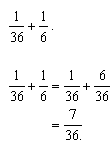
592_What is Unreducing Fractions4.png


You need to make the denominators match before you can add them, If you unreduced the second fraction by multiplying the numerator and denominator by 6, you get :

An example involving whole numbers: Suppose you want to change the number 7 into a fraction with denominator 5. What do you do? Remember, you can change a whole number into a fraction like this:

7 = 7 / 1

And then you can multiply the numerator and denominator by 5, like this:

7 = 7/1 = 35/5


Related Discussions:- What is unreducing fractions

Differntial equation, (3x+2)^2 d^2y/dx^2+3(3x+2)dy/dx-36y=3x^2+4x+1

(3x+2)^2 d^2y/dx^2+3(3x+2)dy/dx-36y=3x^2+4x+1

Math, could you help me get bater at math

could you help me get bater at math

The definition of the limit, The Definition of the Limit In this secti...

The Definition of the Limit In this section we will look at the precise, mathematical definition of three types of limits we'll be looking at the precise definition of limits

Math help, Can you help me with what goes into 54

Can you help me with what goes into 54

Sequences, what is the answer to 2.1 to 4.2

what is the answer to 2.1 to 4.2

Reduction of order, We're here going to take a brief detour and notice solu...

We're here going to take a brief detour and notice solutions to non-constant coefficient, second order differential equations of the form. p (t) y′′ + q (t ) y′ + r (t ) y = 0

Matrix of r, Let R be the relation on S = {1, 2, 3, 4, 5} defined by R =...

Let R be the relation on S = {1, 2, 3, 4, 5} defined by R = {(1,3); (1, 1); (3, 1); (1, 2); (3, 3); (4, 4)}. (b) Write down the matrix of R. (c) Draw the digraph of R.

LPP, howto know whether a region is bounded or not

howto know whether a region is bounded or not

Write Your Message!

Captcha
Free Assignment Quote

Assured A++ Grade

Get guaranteed satisfaction & time on delivery in every assignment order you paid with us! We ensure premium quality solution document along with free turntin report!

All rights reserved! Copyrights ©2019-2020 ExpertsMind IT Educational Pvt Ltd