What do you mean by magnetic circuits, Electrical Engineering

Assignment Help:

Q. What do you mean by Magnetic circuits?

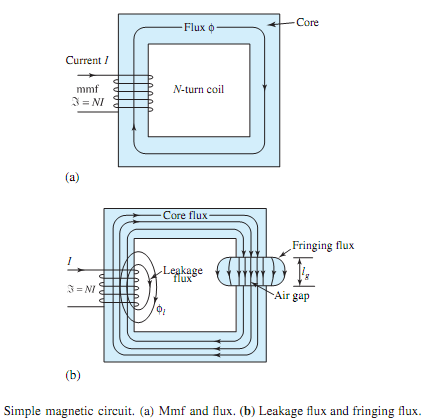
A magnetic circuit provides a path for magnetic flux, just as an electric circuit provides a path for electric current.Magnetic circuits are integral parts of transformers, electric machines, and many other common devices such as doorbells. Analogous to voltage (electric potential difference) in the electric circuit, in a magnetic circuit we have the magnetomotive force (mmf), or the magnetic potential difference which produces a magnetic field, and which has units of amperes or ampere turns. The two sources of mmf in magnetic circuits are the electric current and the permanent magnet (which stores energy and is capable of maintaining a magnetic field with no expenditure of power). The current source is commonly a coil of N turns, carrying a current I known as the exciting current; the mmf is then said to be NI At.
184_What do you mean by Magnetic circuits.png

Figure (a) shows, schematically, a simple magnetic circuit with an mmf ℑ (= NI) and magnetic flux φ. Note that the right-hand rule gives the direction of flux for the chosen direction of current. The concept of a magnetic circuit is useful in estimating the mmf (excitation ampere-turns) needed for simple electromagnetic structures, or in finding approximate flux and flux densities produced by coils wound on ferromagnetic cores.Magnetic circuit analysis follows the procedures that are used for simple dc electric circuit analysis. Calculations of excitation are usually based on Ampere's law, given by

999_What do you mean by Magnetic circuits1.png

where H(| ¯H|= B/µ) is the magnetic field intensity along the path of the flux. If the magnetic field strength is approximately constant (H = HC) along the closed flux path, and lC is the average (mean) length of the magnetic path in the core, Equation can be simplified as

2324_What do you mean by Magnetic circuits2.png

Analogous to Ohm's law for dc electric circuits, we have this relation for magnetic circuits,

2040_What do you mean by Magnetic circuits3.png

where µ is the permeability, A is the cross-sectional area perpendicular to the direction of l, and l stands for the corresponding portion of the length of the magnetic circuit along the flux path. Based on the analogy betweenmagnetic circuits and dc resistive circuits, Table summarizes the corresponding quantities. Further, the laws of resistances in series and parallel also hold for reluctances.


Related Discussions:- What do you mean by magnetic circuits

For sign flag , For Sign Flag  CP ( Call on plus ) CM (Call on minus ...

For Sign Flag  CP ( Call on plus ) CM (Call on minus ) Instruction CP call  the subroutine  from the  specified  memory  location if  sign flag is not set or reset( S=0)

Binary number system - number systems , Binary  Number Systems As men...

Binary  Number Systems As mentioned  earlier this  number is used by  digital  systems like  microprocessor  and other  digital  circuits. This  number  systems  use only two

Determine the line current-total apparent power, A balanced three phase, fo...

A balanced three phase, four wire, WYE connect load consisting of per phase resistenance of A ohms and inductive reactance of D ohms/phase is connected to a B000 V three phase sour

Explain resistivity, Explain Resistivity. Resistivity : Resistance R o...

Explain Resistivity. Resistivity : Resistance R of a wire containing cross-sectional area A and length L maintain the relationship, - R α L and R α 1/A; that is resulting R α

Analog circuit, What is the disadvantages of diodes as a series element in ...

What is the disadvantages of diodes as a series element in a clipper?

Find the frequency domain characteristics, This question is about linear fi...

This question is about linear filtering concepts using the built in filtering functions (it is not about edge detection methods). Load the MRI image of Q4 above and perform the

Comparison of analog-modulation systems, Comparison of Analog-Modulation Sy...

Comparison of Analog-Modulation Systems The comparison of analog modulation systems (conventional AM, DSB SC, SSB SC, VSB, FM, and PM) can be based on three practical criteria:

Distribution - salient features of nep, Distribution: This has been re...

Distribution: This has been recognized as the most critical segment of the electricity business. Here the NEP calls for proper restructuring of distribution utilities for achi

Write Your Message!

Captcha
Free Assignment Quote

Assured A++ Grade

Get guaranteed satisfaction & time on delivery in every assignment order you paid with us! We ensure premium quality solution document along with free turntin report!

All rights reserved! Copyrights ©2019-2020 ExpertsMind IT Educational Pvt Ltd