Utilize the chain rule to differentiate, Mathematics

Assignment Help:

Chain Rule : Assume that we have two functions f(x) & g(x) and they both are differentiable.

1.   If we define F ( x ) = ( f o g ) ( x ) then the derivative of F(x) is,

                            F ′ ( x ) = f ′ ( g( x )) g′ ( x )

2.   If we have y = f (u ) and u = g ( x ) then the derivative of y is,

                     dy /dx= dy / du  .du/  dx

Each forms have their uses, though we will mostly work with the first form in this class.

Now, use the Chain Rule on the function which we used while we opened this section.

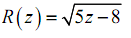
Example:  Utilize the Chain Rule to differentiate
2434_chain rules.png

Solution : Already we've identified the two functions that we required for the composition, however let's write them back down anyway & take their derivatives.

f ( z ) =√z                           g ( z ) = 5z - 8

f ′ ( z ) =1/2 √ z                  g′ ( z ) =5

Thus, by using the chain rule we get,

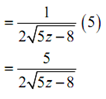
R′ (z ) = f ′ ( g ( z )) g′( z )

=f ′ (5z - 8) g′ ( z )

= 1/2 (5z - 8)-(1/2)(5)
1115_chai rules2.png

And it is what we got by using the definition of the derivative.


Related Discussions:- Utilize the chain rule to differentiate

Find distance between points (b + c, Find the distance between the points (...

Find the distance between the points (b + c, c + a) and (c + a, a + b) . Ans : Use distance formula

Differential equation and laplace transform, 1. Solve the given differentia...

1. Solve the given differential equation, subject to the initial conditions: . x2y''-3xy'+4y = 0 . y(1) = 5, y'(1) = 3 2. Find two linearly independent power series soluti

Geometry, #pqrs is a parallelogram its adjacent side is 2:1.state tHE angle...

#pqrs is a parallelogram its adjacent side is 2:1.state tHE angles

Real and distinct roots, Now we start solving constant linear, coefficient ...

Now we start solving constant linear, coefficient and second order differential and homogeneous equations. Thus, let's recap how we do this from the previous section. We start alon

Limit, limit x APProaches infinity (1+1/x)x=e

limit x APProaches infinity (1+1/x)x=e

Sketch the direction field for the differential equation, Sketch the direct...

Sketch the direction field for the subsequent differential equation. Draw the set of integral curves for this differential equation. Find out how the solutions behave as t → ∞ and

Ratio, how to do them?

how to do them?

Factors, what are the factors af 34?

what are the factors af 34?

Standard normal distribution, Q. Describe Standard Normal Distribution? ...

Q. Describe Standard Normal Distribution? Ans. The Standard Normal Distribution has a mean of 0 and a standard deviation of 1. The letter Z is often used to refer to a sta

Determine the size of belt, On a piece of machinery, the centers of two pul...

On a piece of machinery, the centers of two pulleys are 3 feet apart, and the radius of each pulley is 6 inches. Determine the size of belt (in feet) is required to wrap around bot

Write Your Message!

Captcha
Free Assignment Quote

Assured A++ Grade

Get guaranteed satisfaction & time on delivery in every assignment order you paid with us! We ensure premium quality solution document along with free turntin report!

All rights reserved! Copyrights ©2019-2020 ExpertsMind IT Educational Pvt Ltd