Unit circle, Mathematics

Assignment Help:

Unit circle: The unit circle is one of the most valuable tools to come out in trig.  Unluckily, most people don't study it as well.

Below is the unit circle with just the first quadrant filled in is represented. The process the unit circle works is to draw a line from the center of the circle outside corresponding to a given angle. Then notify at the coordinates of the point where the line & the circle intersect. The first coordinate is the cosine of that angle & the second coordinate is the sine of that angle. We've put some of the basic angles along with the coordinates of their intersections on the unit circle.  Hence, from the unit circle below we can illustrates that cos (? /6 ) = √3 /2 and sin (?/6)= 1/2 .
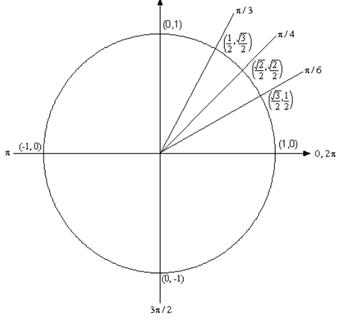
1143_unit circle.png

Keep in mind how the signs of angles work.  If you rotate into a counter clockwise direction the angle is +ve and if you rotate into a clockwise direction the angle is negative.

Remember as well that one complete revolution is 2 ? , thus the positive x-axis can correspond to either an angle of 0 or 2 ? (or 4 ? , or 6 ? , or -2 ? , or -4 ? , etc. based on the direction of rotation). Similarly, the angle ? /6 given angles: (to pick an angle totally at random) can also be any of the

? /6  +2 ? = 13 ?/6  (start at ? /6  then rotate once around counter clockwise)

? /6  + 4 ? = 25 ?/6  (start at ?/6  then rotate around twice counter clockwise)

? /6  -2 ?=11 ?/6 (start at ?/6      then rotate once around clockwise)

? /6  - 4 ? = 23 ?/6   (start at ?/6 then rotate around twice clockwise)

etc.

Actually ?/6 can be any of the given angles  ?/6 + 2 ? n , n = 0, ±1, ± 2, ±  3,.. In this case n refer to the number of complete revolutions you make around the unit circle begining at 6  .  Positive values of n correspond to counter clockwise rotations & -ve values of n correspond to clockwise rotations.

If you know the first quadrant then you can easily get all the other quadrants from the first along with a small application of geometry.


Related Discussions:- Unit circle

Proof f(x) + g(x) dx = f(x) dx + g(x) dx anti-derivation, Proof of: ...

Proof of: ∫ f(x) + g(x) dx = ∫ f(x) dx + ∫g(x) dx It is also a very easy proof. Assume that F(x) is an anti-derivative of f(x) and that G(x) is an anti-derivative of

Algebra, solutions for the equation a-b=5

solutions for the equation a-b=5

Which of the following sets are equal, Which of the following sets are equa...

Which of the following sets are equal? S 1 = {1, 2, 2, 3}, S 2 = {x | x 2 - 2x + 1 = 0}, S 3 = {1, 2, 3}, S 4 = {x | x 3 - 6x

Las leyes de kepler, la expresión que permite calcular el radio medio de la...

la expresión que permite calcular el radio medio de la órbita de cada planeta es?

Jay bought twenty-five $0.37 stamps how much did he spend, Jay bought twent...

Jay bought twenty-five $0.37 stamps. How much did he spend? To ?nd how much Jay spent, you must multiply the cost of each stamp ($0.37) through the number of stamps purchased (

How many more cm are required to reach the average monthly, Thomas is remai...

Thomas is remaining track of the rainfall in the month of May for his science project. The first day, 2.6 cm of rain fell. On the second day, 3.4 cm fell. On the third day, 2.1 cm

Probability of independent events, Q. Probability of Independent Events? ...

Q. Probability of Independent Events? Ans. Consider these two events:  {My name is Shirley} {The rain is falling} Are these events related to each other?  No.  My name

Substitution rule for definite integrals, Substitution Rule for Definite In...

Substitution Rule for Definite Integrals Now we need to go back and revisit the substitution rule as it also applies to definite integrals.  At some level there actually isn't

Taylor series, If f(x) is an infinitely differentiable function so the Tayl...

If f(x) is an infinitely differentiable function so the Taylor Series of f(x) about x=x 0 is, Recall that, f (0) (x) = f(x) f (n) (x) = nth derivative of f(x)

Find the area of the shaded region of square, In the adjoining figure, ABCD...

In the adjoining figure, ABCD is a square of side 6cm.  Find the area of the shaded region. Ans:    From P draw PQ ⊥ AB AQ = QB = 3cm (Ans: 34.428 sq cm) Join PB

Write Your Message!

Captcha
Free Assignment Quote

Assured A++ Grade

Get guaranteed satisfaction & time on delivery in every assignment order you paid with us! We ensure premium quality solution document along with free turntin report!

All rights reserved! Copyrights ©2019-2020 ExpertsMind IT Educational Pvt Ltd