Types of blastula, Biology

Assignment Help:

TYPES OF BLASTULA -

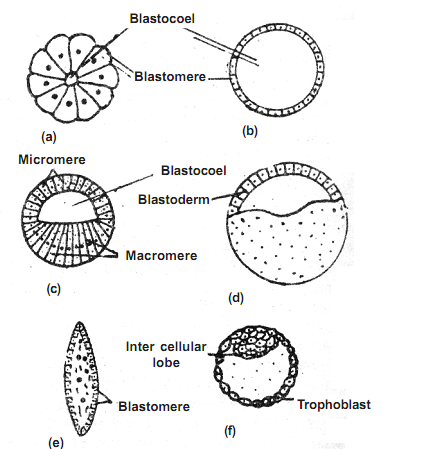
Blastulas are of following type -

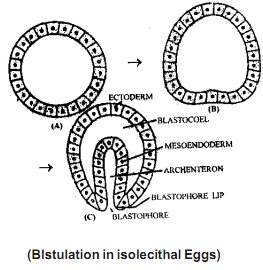
1567_blastulation.png                  876_blastulation1.png

1.       STEREOBLASTULA -

The blastocoel is very small. It's blastomere are less in number but large in size.

It is formed as a result of spiral cleavage. eg. Neries and some molluscs.

2.       COELOBLASTULA -

The blastula of echinoderm and amphioxis is called coeloblastula.

It is formed through complete holoblastic cleavage. The blastoderm is formed of a single layer of cells.

Its blastocoel is filled wiht mucopolysaccaharide. In microlecithal egg blastocoel is centric.

In megalecithal egg blastocoel is excentric, eg. Some animal of echinodermes and amphioxis.

3.       PERIBLASTULA OR SUPERFICIAL BLASTULA -

It is formed as a result of superficial cleavage. The blastocoel is absent.

There is a single layer of blastomeres around the uncleaved yolky part, eg. Insect.

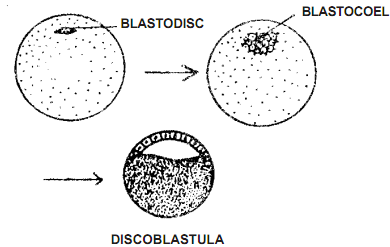
4.       DISCOBLASTULA -

It is formed as a result of discoidal cleavage. The blastocoel is small & it is called as subgerminal space. It is situated below the blastoderm, eg. Boney fishes, reptile, birds & prototherian mammals.
1732_blastula.png

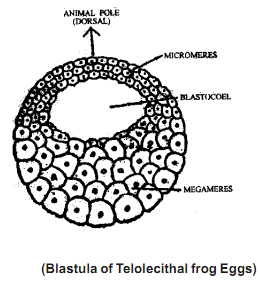
5.      AMPHIBLASTULA -

It is formed of two types of structurally different blastomeres.

Example, in sycon the anterior half fo blastula is formed of flagellated cells while the posterior half is formed of large rounded granular cells on in amphibians where the two types of cells are micromeres and macromeres.

eg. Amphibians.

6.      BLASTOCYST -

It is formed in mammals as a result of holoblastic cleavage.

Outer cells are called as trophoblasts or cells of Rauber. They form a trophoderm. This layer get attached to the uterine wall.

Inner cells form the embryo & are called as inner cell mass.

eg. Human beings.
1893_types of blastula.png


Related Discussions:- Types of blastula

Polysaccharides, PO L YSACCHARIDES Polysaccharides are complex car...

PO L YSACCHARIDES Polysaccharides are complex carbohydrates. Polysaccharides are also called glycans. These are insoluble in water. Polysaccharides are not swee

Batelnut, B A TELNU T - Kernel of the betalnut palm, areca catechu, ...

B A TELNU T - Kernel of the betalnut palm, areca catechu, enclosed in betal leaves and mixed with an aromatic paste is chewed extensively in India & Africa. It contains arec

Describe the terms cellular location and the basic processes, Describe cell...

Describe cellular location and the basic processes of photosynthesis.

What is rearrangement reaction, PREPARATION OF BENZILIC ACID 1.  What i...

PREPARATION OF BENZILIC ACID 1.  What is rearrangement reaction? The reactions in which the carbon of the molecule is rearranged to give a structural isomer of the original

Blood coagulation, BLOOD COAGULATION -   DEFINITIO N - The pro...

BLOOD COAGULATION -   DEFINITIO N - The property of blood to change from fluid to gel state within a few minutes of its coming in contact with air is called blood coag

Define the thin and thick filaments of a sarcomere, When the overlap betwee...

When the overlap between the thin and thick filaments of a sarcomere in a skeletal muscle is decreasing, A. the total length of the I band is increasing in the sarcomere. B.

What is orthopedic, Orthopedic Prophylactic antistaphylococcal drugs ad...

Orthopedic Prophylactic antistaphylococcal drugs administered preoperatively can decrease the incidence of both early and late infection following joint replacement. They also

Define the remodeling rate, Q. Define the Remodeling rate? Human corti...

Q. Define the Remodeling rate? Human cortical bone: 2-10%  per year depending on site and age of patient. Trabecular bone: Higher turnover rate 20-30% per year. In a stu

Transpiration the only way through which leaves lose water, Is the transpir...

Is the transpiration the only way through which leaves lose water? The Plants don't only lose water as vapor as by transpiration. Leaves also lose liquid water by a phenomenon

Explain human development, Explain Human Development? Human development...

Explain Human Development? Human development begins with fertilization, and continues throughout life. Fertilization occurs when two sex cells, a sperm cell and an egg cell, jo

Write Your Message!

Captcha
Free Assignment Quote

Assured A++ Grade

Get guaranteed satisfaction & time on delivery in every assignment order you paid with us! We ensure premium quality solution document along with free turntin report!

All rights reserved! Copyrights ©2019-2020 ExpertsMind IT Educational Pvt Ltd