Solve the subsequent quadratic equation, Mathematics

Assignment Help:

Solve the subsequent quadratic equation:

Solve the subsequent quadratic equation through taking the square roots of both sides.

3x2 = 100 - x2

Solution:

Step 1. Using the addition axiom, add x2 to both sides of the equation.

3x2  + x2          = 100 - x2  + x2

4x2       = 100

Step 2. Using the division axiom, divide both sides of the equation through 4.

4x 2 /4 = 100/4

x2  = 25

Step 3. Take the square root of both sides of the equation.


x2         = 25

√x2       = √25

x          = ±5

Thus, the roots are x = +5 and x = -5.

Step 4. Check the roots.

3x2       = 100 - x2

3(±5)2  = 100 - (±5)2

3(25)    = 100 - 25

75        = 75

If a pure quadratic equation is written in common form, a general expression can be written for its roots.  The common form of a pure quadratic is the subsequent.

ax2 + c = 0                                                                 

Using the subtraction axiom and subtract c from both sides of the equation.

ax2 = -c

Using the division axiom and divide both sides of the equation by a.

x2  = - c/a

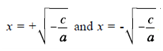
Now take the square roots of both sides of the equation.

256_Solve the subsequent quadratic equation.png                                                            

Therefore, the roots of a pure quadratic equation written in common form ax2 + c = 0 are 1884_Solve the subsequent quadratic equation1.png.

Related Discussions:- Solve the subsequent quadratic equation

Fibonacci number, 1. Suppose n ≡ 7 (mod 8). Show that n ≠ x 2 + y 2 + z 2...

1. Suppose n ≡ 7 (mod 8). Show that n ≠ x 2 + y 2 + z 2 for any x, y, z ε Z. 2. Prove ∀n ε Z, that n is divisible by 9 if and only if the sum of its digits is divisible by 9.

How many feet huge is her dining room, Audrey measured the width of her din...

Audrey measured the width of her dining room in inches. It is 150 inches. How many feet huge is her dining room? There are 12 inches in a foot. Divide 150 by 12 to find out the

Discrete-time signal, Determine the fundamental period of the following dis...

Determine the fundamental period of the following discrete-time signal: X(n) = 2sin(4n)π +π/4) + 5sin16n +4sin (20n +π/3)

By the method of completion of squares solve equation, By the method of com...

By the method of completion of squares show that the equation 4x 2 +3x +5 = 0 has no real roots. Ans:    4 x 2 +3 x +5=0 ⇒  x 2 + 3/4 x + 5 = 0 ⇒   x 2 + 3/4 x +

Calculus, find or evaluate the integral integrate((e^2x + e^x + 1)/(e^x))dx...

find or evaluate the integral integrate((e^2x + e^x + 1)/(e^x))dx

Solution to an equation or inequality, First, a solution to an equation or ...

First, a solution to an equation or inequality is any number that, while plugged into the equation/inequality, will satisfy the equation/inequality. Thus, just what do we mean by

Innovation, In the innovations algorithm, show that for each n = 2, the inn...

In the innovations algorithm, show that for each n = 2, the innovation Xn - ˆXn is uncorrelated with X1, . . . , Xn-1. Conclude that Xn - ˆXn is uncorrelated with the innovations X

Find out the area under the parametric curve, Find out the area under the p...

Find out the area under the parametric curve given by the following parametric equations.  x = 6 (θ - sin θ) y = 6 (1 - cos θ) 0 ≤ θ ≤ 2Π Solution Firstly, notice th

Write Your Message!

Captcha
Free Assignment Quote

Assured A++ Grade

Get guaranteed satisfaction & time on delivery in every assignment order you paid with us! We ensure premium quality solution document along with free turntin report!

All rights reserved! Copyrights ©2019-2020 ExpertsMind IT Educational Pvt Ltd