Show operation on jfet, Electrical Engineering

Assignment Help:

Q. Show Operation on JFET?

The junction in the JFETis reverse-biased for normal operation.No gate current flows because of the reverse bias and all carriers flow from source to drain. The corresponding drain current is dependent on the resistance of the channel and the drain-to-source voltage vDS.As vDS is increased for a given value of vGS, the junction is more heavily reverse-biased, when the depletion region extends further into the conducting channel. Increasing vDS will ultimately block or pinch off the conducting channel. After the pinch-off, the drain current iD will be constant, independent of vDS.
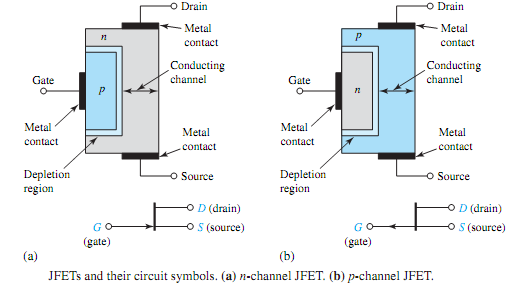
693_Show Operation on JFET1.png

It is the active region beyond pinch-off that is useful for the controlled-source operation, since only changes in vGS will produce changes in iD. Figure illustrates the JFET characteristics. Part (a) shows the idealized static characteristics with two regions separated by the dashed line, indicating the ohmic (controlled-resistance or triode) region and the active (controlled-source) region beyond pinch-off. Note that iD is initially proportional to vDS in the ohmic region where the JFET behaves much like a voltage-variable resistance; iD depends on vGS for a given value of vDS in the active region. In a practical JFET, however, the curves of iD versus vDS are not entirely flat in the active region but tend to increase slightly with vDS, as shown in Figure(b);

when extended, these curves tend to intersect at a point of -VA on the vDS axis. Another useful characteristic indicating the strength of the controlled source is the transfer characteristic, relating the drain current iD to the degree of the negative bias vGS applied between gate and source; a cutoff region exists, indicated by the pinch-off voltage -VP , for which no drain current flows, because both vGS and vDS act to eliminate the conducting channel completely.

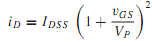
Mathematically, the drain current in the active controlled-source region is approximately given by:
361_Show Operation on JFET.png

where IDSS, known as the drain-source saturation current, represents the value of iD when vGS = 0.


Related Discussions:- Show operation on jfet

Explain the electrical contact materials with examples, Explain the electri...

Explain the electrical contact materials with examples. Electrical contact materials: A number of elements in their pure form as copper, nickel, palladium, molybdenum, platin

How can magnetic fields can be plot, The magnetic fields can be plot by usi...

The magnetic fields can be plot by using: i.  Compass ii.  Iron dust method  .

Sparking with electrical equipment, Sparking : In ordinary domestic situat...

Sparking : In ordinary domestic situations, small electrical sparks are usually not hazardous. In certain conditions which are frequently encountered in science labs, even the sma

Load resistor , a) Include a Smoothing Capacitor to the Rectifier circuit a...

a) Include a Smoothing Capacitor to the Rectifier circuit and calculate the Output Voltage and Frequency b) Include a 47Ω Load Resistor and sketch the schematic diagram of the c

Obtain a bode magnitude plot for the transfer function, Q. A bandpass filte...

Q. A bandpass filter circuit is shown in Figure. Develop a PSpice program and use PROBE to obtain a Bode magnitude plot for the transfer function ¯H(f) = ¯Vout/ ¯Vin for frequency

Determine the equivalent winding resistance, Determine the equivalent windi...

Determine the equivalent winding resistance: A 50 kVA, 2200/110 V, 50 HZ' transformer contain an HV winding resistance of 0.15 Ω and a leakage reactance of 0.45 Ω. The LV wind

Explain load flow analysis, Explain Load Flow Analysis The method commo...

Explain Load Flow Analysis The method commonly used for load flow analysis is the nodal analysis. The nodal analysis method is given in many books on circuit theory and is base

Determine the current by mesh analysis, Q. Determine the current I through ...

Q. Determine the current I through the 10- resistor of the circuit of Figure by employing the node-voltage method. Check by mesh analysis.

Find the torque supplied to the mechanical load, Q. The machine of Problem ...

Q. The machine of Problem can be used as a motor. Let the terminals of the coil be connected to a voltage source of 1 kV rms. If the motor runs at 1800 r/min and draws a current of

Write Your Message!

Captcha
Free Assignment Quote

Assured A++ Grade

Get guaranteed satisfaction & time on delivery in every assignment order you paid with us! We ensure premium quality solution document along with free turntin report!

All rights reserved! Copyrights ©2019-2020 ExpertsMind IT Educational Pvt Ltd