Rules for indexed tables, COBOL Programming

Assignment Help:

RULES FOR INDEXED TABLES:

The rules of indexing a table with an INDEXED phrase are as shown below:

(1) If indexing is completed for any one level of a table, then indexing should be used for all levels. Therefore it will be an error if in the above the INDEXED phrase is used only for FACULTY and not for the DEPARTMENT and YEAR.

(2) The Index names cannot be used in combination with the subscripts. And hence, a reference as YEAR (F1, S2, S3) will be treated as an error as F1 is an index name but S2 and S3 are data names. Though, index names can be used in a combination with numeric positive integral literals. Therefore YEAR (F1, 2, 3) is valid as F1 is an index name, while 2 and 3 are numeric integral literals.

(3) Indexes are valid only for the tables where they have been identified. The Indexes for one table cannot be used for the other table. Therefore F1, D1 and Y1, being indexes for the table ENROLL-TABLE, cannot be used for other tables in similar program.

(4) The index names should be exclusive. The same index name should not be used for various levels of a table.

(5) The indexes should not appear anywhere in the DATA DIVISION except in the INDEXED phrase of the OCCURS clause. This means that the index names must be implicitly defined and must not be defined explicitly.

(6) The Indexes can be manipulated only by the SEARCH, SET and PERFORM statements. The value of an index is frequently known as the occurrence number. The internal presentation of the occurrence number is system dependent.

(7) An index can be coded plus or minus an integer literal for the relative addressing of the table elements. For illustration, YEAR (F1+1, D1-2, Y1-1) is valid. If F1, D1 and suppose that the value 1,3 and 4 respectively then this will refer to the third YEAR of the first DEPARTMENT of the second FACULTY.

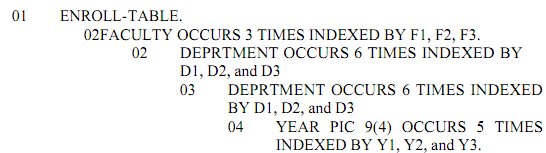
(8) There can be more than one index for each level. For illustration, the ENROLL-TABLE can also be defined as
1783_RULES FOR INDEXED TABLES.png


Related Discussions:- Rules for indexed tables

Rewrite statement - relative files, REWRITE STATEMENT: The REWRITE st...

REWRITE STATEMENT: The REWRITE statement has the format for a relative file as shown below, REWRITE record-name  [ FORM identifier ]

Column and field in cobol program, Column and Field in COBOL program: ...

Column and Field in COBOL program: In COBOL there are 2 types of entries termed as margin A and margin B entries. The Margin A entries start from the column 8, 9, 10 or 11 and

Read statement, READ STATEMENT: The aim of this verb is to make availa...

READ STATEMENT: The aim of this verb is to make available the next logical record from the input file. It is important to note the meaning of the "next" logical record in the

Comma - edit characters for numeric data, , (Comma) : A comma, wheneve...

, (Comma) : A comma, whenever used in a picture, is considered as an insertion character and inserted wherever it become visible. There can be more than one comma in the pictu

Kirat da satikar, bal majduri ik kanuni apradh hai is de bavjud bache ,ghra...

bal majduri ik kanuni apradh hai is de bavjud bache ,ghra,hotla,road, kam karn lai majbur han bacheya te mapeya nu parhai val prerit karn lai ik bashan teyar kro

If statement - cobol programming, IF STATEMENT: The easiest form of th...

IF STATEMENT: The easiest form of the IF statement is  IF condition-1 statement-1 where the condition-1 may be any one from the shown below. When the condition-1

File-control paragraph for the relative files, FILE-CONTROL paragraph for t...

FILE-CONTROL paragraph for the relative files: The normal format for the SELECT clause for a relative file is as shown below. SELECT  file-name  ASSIGN  TO  implementor-nam

Illustration of multiply verb, Illustration of Multiply verb: (a)  MUL...

Illustration of Multiply verb: (a)  MULTIPLY A BY B. In this situation the value of A & B will be multiplied and the product will be stored in B.  The decimal point locatio

Example of compound condition, Example of compound condition: In commo...

Example of compound condition: In common, a compound condition has the form which is as shown below: Where condition-1 & condition-2 can be any one of the below:

Program for subtract verb, PROGRAM FOR SUBTRACT VERB: We have to write...

PROGRAM FOR SUBTRACT VERB: We have to write a simple program to elaborate the SUBTRACT verb. You can also use edit characters in the program. Identification division. Pr

Write Your Message!

Captcha
Free Assignment Quote

Assured A++ Grade

Get guaranteed satisfaction & time on delivery in every assignment order you paid with us! We ensure premium quality solution document along with free turntin report!

All rights reserved! Copyrights ©2019-2020 ExpertsMind IT Educational Pvt Ltd