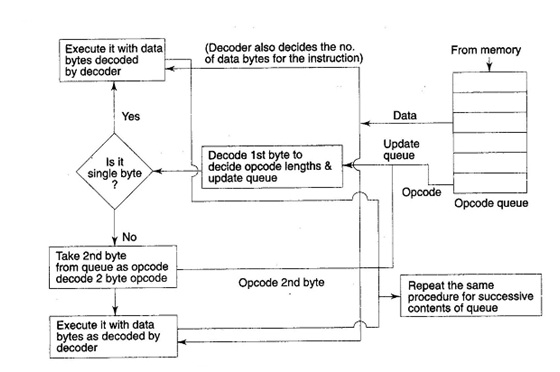
Queue operation-microprocessor, Assembly Language

Assignment Help:

Queue Operation :

326_queue operation.jpg


RQ/CT0, RQ/G1-Request/Grant:  These pins are utilized by other local bus masters, in themaximum mode, to force the processor to release the local bus at the end of the processor's current bus cycle. Each of the pins is bi- directional with RQ/GT () having greater priority than RQ/GT1.  RQ/GT pins have pull up internally resistors and can be left unconnected. The request& grant sequence is described below.

1) A pulse1 clock wide from another bus master requests the bus access to 8086.

2) During 74 (current)  or T, (next) clock cycle, a pulse 1 clock wide from 8086 to the requesting master,  show  that the 8086  has allowed  the local  bus  to float  and that it will enter  the "hold acknowledge" state at next clock cycle. The CPU's bus interface unit is probable to be disconnected from the local bus of the system.

 3) A 1 clock wide pulse from the master indicates to 8086 that the 'hold' request is just going to end and the 8086 can regain control of the local bus at the next clock cycle.

Thus each master to master exchange of the local bus is a sequence of 3 pulses. There might be at least 1 dead clock cycle after each bus exchange. The request &grant pulses are active low. Those are received for the bus requests when 8086 is performing I/O cycle or memory, the granting of the bus is ruled by the rules as discussed in case of, HLDA andHOLD in minimum mode.

Yet now, we have described the architecture and pin configuration of 8086. Next, we will study some operational features of 8086 based systems.


Related Discussions:- Queue operation-microprocessor

Addressing modes for sequential control-microprocessor, The addressing mode...

The addressing modes for the sequential control transfer instructions are described below:   1. Immediate: Immediate data is a part of instruction,in this type of addressin

Adc-arithmetic instruction-microprocessor, ADC: Add with Carry:- This instr...

ADC: Add with Carry:- This instruction performs the similar operation a like ADD instruction, but adds the carry flag bit (which might be set as a result of the previous calculatio

Register organization of 8086-microprocessor, Register Organization of 8086...

Register Organization of 8086 8086  has  a great  set  of registers  containing  special  purpose and general  purpose  registers.  All the 8086 resisters are 16-bit registers.

Help with homework (python), i have trying to do the homework but there is ...

i have trying to do the homework but there is a mistake. (Counting positive and negative numbers and computing the average of numbers) write a program that reads an unspecified nu

Copy a string backwards, I can get it to copy the string but can''t get it ...

I can get it to copy the string but can''t get it to reverse it.

Physical memory mapped and port input output-microprocessor, Physical Memor...

Physical Memory Mapped I/O and Port I/O : CPU controlled I/O comes in 2 ways. Simply the difference is whether we utilize the normal memory addresses for I/O, this is mention

Program to add contents in memory-machine level programs, Example : Add th...

Example : Add the contents of the 2000H: 0500H memory location to contents of 3000H: 0600H and store the result in 5000H: 0700H. Solution : Unlike the past example progra

Instructions, Difference between div and idiv

Difference between div and idiv

Assignment, 1. Write an assembly program that adds the elements in the odd ...

1. Write an assembly program that adds the elements in the odd indices of the following array. Use LOOP. What is the final value in the register? array1 DWORD 10, 20, 30, 40, 50, 6

Write Your Message!

Captcha
Free Assignment Quote

Assured A++ Grade

Get guaranteed satisfaction & time on delivery in every assignment order you paid with us! We ensure premium quality solution document along with free turntin report!

All rights reserved! Copyrights ©2019-2020 ExpertsMind IT Educational Pvt Ltd