Proof of root test - sequences and series, Mathematics

Assignment Help:

Proof of Root Test 

Firstly note that we can suppose without loss of generality that the series will initiate at n = 1 as we've done for all our series test proofs.  As well note that this proof is very identical to the proof of the Ratio Test. Let us start off the proof here by suppose that 1 L < and we will need to illustrate that ∑an is absolutely convergent.  To do this let's first note that as L < 1 there is some number r like L < r < 1.

Now, remind that,
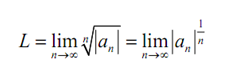
2166_Proof of Root Test 1.png

and because we as well as have chosen r such that  L< r there is some N like if  n ≥ N we will have,

1847_Proof of Root Test 2.png

Here now the series

1312_Proof of Root Test 3.png

is a geometric series and as 0 < r < 1 we in fact know that it is a convergent series. As well because |an < rn| n≥N  through the Comparison test the series

1540_Proof of Root Test 4.png

is convergent. Though since,

2204_Proof of Root Test 5.png

we are be familiar with that

391_Proof of Root Test 6.png

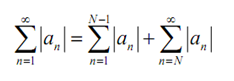
is as well convergent as the first term on the right is a finite sum of finite terms and hence finite.  Hence

525_Proof of Root Test 7.png

is absolutely convergent.

Subsequently, we need to assume that L >1 and we'll need to illustrate that ∑an is divergent. reminding that,
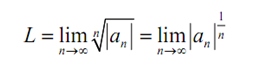
1145_Proof of Root Test 8.png

and as L > 1 we know that there should be some N such that if  n > N we will have,

35_Proof of Root Test 9.png

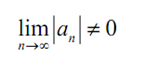
Though, if  |an| > 1 for all  n ≥ N after that we know that,
1899_Proof of Root Test 10.png

The meaning of this is like this:

1338_Proof of Root Test 11.png

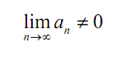
Hence, by the Divergence Test ∑an is divergent.

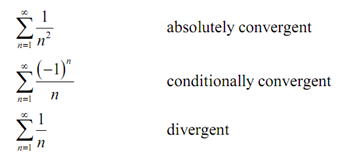
At last, we need to assume that L= 1and show that we could get a series which has any of the three possibilities.  To do this we just require a series for each case.  We'll leave the facts of checking to you but all three of the following series have L= 1 and each one shows one of the probabilities.
2403_Proof of Root Test 12.png


Related Discussions:- Proof of root test - sequences and series

Characteristics of time series, Characteristics of Time Series Time se...

Characteristics of Time Series Time series has the given characteristics. a) A long term trend (T) -tendency of the whole series to fall and rise. b) Seasonal variati

Measurement of the sampling distribution, Caterer determines that 87% of p...

Caterer determines that 87% of people who sampled the food thought it was delicious. A random sample of 144 out of population of 5000 taken. The 144 are asked to sample the food. I

Find var (3x+8) where x is a random variable, If Var(x) = 4, find Var (3x+8...

If Var(x) = 4, find Var (3x+8), where X is a random variable. Var (ax+b) = a 2 Var x Var (3x+8) = 3 2 Var x = 36

Volume of grains in the silo , The volume of grains in a silo at a particul...

The volume of grains in a silo at a particular time (measured in hours) is given by V (t) = 4t(3-t) m3. Find the rate of change of the volume of grains in the silo from first princ

The perimeter square can be expressed as x + 4 estimate x, The perimeter of...

The perimeter of a square can be expressed as x + 4. If one side of the square is 24, what is the value of x? Since the perimeter of the square is x + 4, and a square has four

Solve step by step, Use an appropriate infinite series method about x = 0 t...

Use an appropriate infinite series method about x = 0 to find two solutions of the given differential equation: y''''-xy''-y=0

Determine radicals in exponent form, Evaluate following.               ...

Evaluate following.                √16 and Solution To evaluate these first we will convert them to exponent form and then evaluate that since we already know how to

Mensuration, A palm tree of heights 25m is broken by storm in such a way th...

A palm tree of heights 25m is broken by storm in such a way that its top touches the ground at a distance of 5m from its root,but is not separated from the tree.Find the height at

Arc length formula - applications of integrals, Arc length Formula L = ...

Arc length Formula L = ∫ ds Where ds √ (1+ (dy/dx) 2 ) dx                                     if y = f(x), a x b ds √ (1+ (dx/dy) 2 ) dy

Write Your Message!

Captcha
Free Assignment Quote

Assured A++ Grade

Get guaranteed satisfaction & time on delivery in every assignment order you paid with us! We ensure premium quality solution document along with free turntin report!

All rights reserved! Copyrights ©2019-2020 ExpertsMind IT Educational Pvt Ltd