Example of integrals involving quadratics, Mathematics

Assignment Help:

Evaluate the following integral.

∫√(x2+4x+5) dx

Solution:

Remind from the Trig Substitution section that to do a trig substitution here we first required to complete the square on the quadratic. This provides,

X2+4x+5 = x2+4x+4-4+5=(x+2)2+1

After completing the square the integral becomes like this:

∫√(x2 + 4x +5) dx

= ∫ √ ((x+2)2 1dx)

Upon doing this we can recognize the trig substitution that we require.  Here it is,

x + 2 = tan θ

x= tan θ -2

dx = sec2 θdθ

√((x + 2)2 +1)

= √ tan2 θ+1

=√ sec2 θ

=|sec θ |

= sec θ

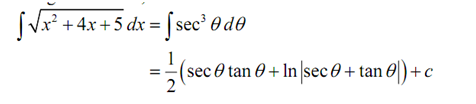
Recall that as we are doing an indefinite integral we be able to drop the absolute value bars.  By using this substitution the integral becomes,
20_Example of Integrals Involving Quadratics 2.png

∫ √x2 + 4x + 5 dx = ∫ sec3 θ d θ

= ½ (secθ tanθ + ln |secθ + tan θ|) + c

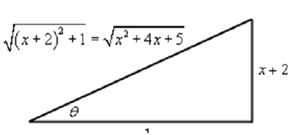
We can end the integral out along with the following right triangle.

tanθ = (x+2/1)

secθ = √(x2 + 4x +5/1)

        = √ (x2+4x+5)
1954_Example of Integrals Involving Quadratics 1.png

∫ √(x2+4x+5) dx = ½ ((x+2)√x2+4x+5+1n|x+2+√x2+4x+5|) + c

Thus, by completing the square we were capable to take an integral that had a general quadratic in it and transform it into a form that permitted us to make use of a known integration technique.


Related Discussions:- Example of integrals involving quadratics

Integration, R={(r, ?):1=r= 2cos? ,-p/3= ? =p/3

R={(r, ?):1=r= 2cos? ,-p/3= ? =p/3

BOUNDARY VALUE PROBLEM, Ut=Uxx+A exp(-bx) u(x,0)=A/b^2(1-exp(-bx)) u(0,t)=0...

Ut=Uxx+A exp(-bx) u(x,0)=A/b^2(1-exp(-bx)) u(0,t)=0 u(1,t)=-A/b^2 exp(-b)

Assumptions of interpolation and extrapolation, Assumptions The f...

Assumptions The figures known are assumed to be a normal series, that is a series without any violent, unexplained fluctuations in the values. The

Circles and cones, length of subnormal to the curve y2=2x+1 at (4,3)

length of subnormal to the curve y2=2x+1 at (4,3)

Determine if the following sequences converge or diverge, Determine if the ...

Determine if the following sequences converge or diverge.  If the sequence converges find out its limit. a. {3n 2 - 1 / 10n + 5n 2 } ∞ n =2 b. {e 2n / n} ∞ n =1 c

Polynomials, simplify the expression 3/5/64

simplify the expression 3/5/64

Shoppers` stop, 3. How are Indian customers visiting Shoppers’ Stop any dif...

3. How are Indian customers visiting Shoppers’ Stop any different from customers of developed western countries? 4. How should Shoppers’ Stop develop its demand forecasts?

Important formulas of functions , Important formulas d (a b )/ dx  = 0...

Important formulas d (a b )/ dx  = 0                              This is a constant d ( x n ) / dx = nx n -1                      Power Rule d (a x ) / dx = a x l

Solving a quadratic equation, In polynomials you have seen expressi...

In polynomials you have seen expressions of the form x 2 + 3x - 4. Also we know that when an expression is equated to zero or some other expression, we cal

Write Your Message!

Captcha
Free Assignment Quote

Assured A++ Grade

Get guaranteed satisfaction & time on delivery in every assignment order you paid with us! We ensure premium quality solution document along with free turntin report!

All rights reserved! Copyrights ©2019-2020 ExpertsMind IT Educational Pvt Ltd