Program insertion of a node into any circular linked list, Data Structure & Algorithms

Assignment Help:

Program Insertion of a node into any Circular Linked List

Figure depicts a Circular linked list from which an element was deleted.

ALGORITHM (Deletion of an element from a Circular Linked List)

Step 1  Begin

Step 2  if the list is empty, element cannot be eliminated.

Step 3  else, if element desire  to be deleted at first node, then make the start (head) to point to the second element.

Step 4  else, Removeelement from the list by calling find function & returning the found address of the element.

Step 5  End.
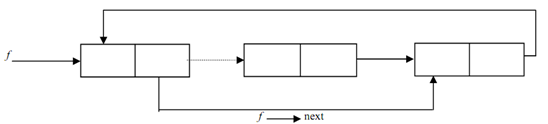
2108_Program Insertion of a node into any Circular Linked List.png

Figure: A Circular Linked List through which an element was deleted

(Dotted line indicates the linked that existed prior to deletion)

Program demonstrated the code for the deletion of an element from the Circular linked list.

#include

#include

#define NULL 0

structlinked_list

{

int data;

structlinked_list *next;

};

typedefstructlinked_listclist;

clist *head, *s;

/* prototype of find and delete_function*/

clist * delete_clist(clist *);

clist * find(clist *, int);

/*description of delete_clist      */

clist *delete_clist(clist *start)

{

int key; clist * f, * temp;

printf("\n enter the element to be deleted \n");

scanf("%d", &key);

if(start->data == key)

{

temp=start->next; free(start);

start=temp;

}

else

{

f = find(start,key);

if(f==NULL)

printf("\n key not fund");

else

{

}

}

temp = f->next->next;

free(f->next);

f->next=temp;


return(start);

}

/*description of find function */

clist * find(clist *start, int key)

{

if(start->next->data == key)

return(start);

if(start->next->next == NULL)

return(NULL);

else

find(start->next, key);

}

void main()

{

voidcreate_clist(clist *);

int count(clist *);

void traverse(clist *);

head=(clist *)malloc(sizeof(clist));

s=head;

create_clist(head);

printf(" \n traversing the created clist and the starting address is %u \n", head);

traverse(head);

printf("\n number of elements in the clist   %d \n", count(head));

head=delete_clist(head);

printf(" \n traversing the clist after delete_clistand starting address is following %u \n",head);

traverse(head);

}

voidcreate_clist(clist *start)

{

printf("inputthe element -1111 for coming out of loop\n");

scanf("%d", &start->data);

if(start->data == -1111)

start->next=s;

else

{

start->next=(clist*)malloc(sizeof(clist));

create_clist(start->next);

}

}

void traverse(clist *start)

{

if(start->next!=s)

{

printf("data is %d \t next element address is %u\n", start->data,  start- traverse(start->next);

}

}

if(start->next == s)

printf("data is %d \t next element address is %u\n",start->data,   start->next);

int count(clist *start)

{

if(start->next == s)

return 0;

else

}

return(1+count(start->next));

Program: Deletion of an element from the circular linked list


Related Discussions:- Program insertion of a node into any circular linked list

Elaborate the symbols of abstract data type, Elaborate the symbols of abstr...

Elaborate the symbols of abstract data type length(a)-returns the number of characters in symbol a. capitalize(a)-returns the symbol generated from a by making its first cha

Program segment for deletion of any element from the queue, Program segment...

Program segment for deletion of any element from the queue delete() { int delvalue = 0; if (front == NULL) printf("Queue Empty"); { delvalue = front->value;

B-tree of degree 3, Q. Explain the result of inserting the keys given. ...

Q. Explain the result of inserting the keys given. F, S, Q, K, C, L, H, T, V, W, M, R, N, P, A, B, X, Y, D, Z, E  in an order to an empty B-tree of degree-3.

Registers, what are registers? why we need register? Definition? Types? Wha...

what are registers? why we need register? Definition? Types? What registers can do for us?

State about the bit string, State about the Bit String Carrier set of...

State about the Bit String Carrier set of the Bit String ADT is the set of all finite sequences of bits, including empty strings of bits, which we denote λ. This set is {λ, 0

Which of the sorting algorithm is stable, Which of the sorting algorithm is...

Which of the sorting algorithm is stable   Heap sorting is stable.

Determine the output of vehicles algorithm, Draw trace table and determine ...

Draw trace table and determine the output from the below flowchart using following data (NOTE: input of the word "end" stops program and outputs results of survey):  Vehicle = c

Sequential search of a list is preferred over binary search, What are the c...

What are the conditions under which sequential search of a list is preferred over binary search? Sequential Search is a preferred over binary search when the list is unordered

Rules for abstract data type-tree, null(nil) = true                     // ...

null(nil) = true                     // nil refer for empty tree null(fork(e, T, T'))= false   //  e : element , T and T are two sub tree leaf(fork(e, nil, nil)) = true leaf(

Database design and sql queries, In assignment, you have already started th...

In assignment, you have already started the process of designing a database for the Beauty Salon mini-case (enclosed again below), mainly in the phase of conceptual database design

Write Your Message!

Captcha
Free Assignment Quote

Assured A++ Grade

Get guaranteed satisfaction & time on delivery in every assignment order you paid with us! We ensure premium quality solution document along with free turntin report!

All rights reserved! Copyrights ©2019-2020 ExpertsMind IT Educational Pvt Ltd