Pointer(ptr)-assemblers directive-microprocessor, Assembly Language

Assignment Help:

PTR : Pointer:-

The pointer operator which is used to declare the type of a variable, label or memory operand. The operator PTR is prefixed by either WORD or BYTE. If the prefix is BYTE, then thespecific label, variable or memory operand is treated as an 8-bit quantity, whereas if WORD is the prefix, then it is treated as a 16-bit quantity.  In other terms, the PTR operator is used to mention the data type - byte or word. The examples of the PTR operator are following:

Example :
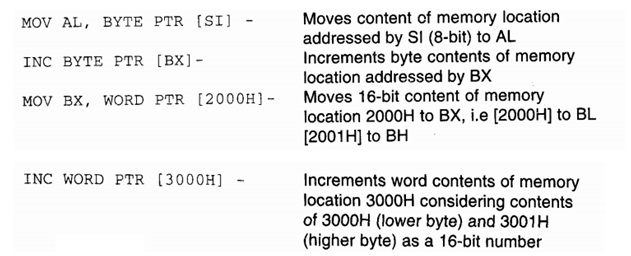
57_ptr.jpg

In particular case of JMP instructions, the PTR operator is used to mention the type of the jump, for example near or far, as describe in the examples given below.

JMP     WORD PTR [BX]-NEAR Jump

JMP     WORD PTR [BX]-FAR Jump

PUBLIC  As  already described,  the PUBLIC directive which is used along with the EXTRN  directive. This give information to the assembler that the variables, labels, constants, or procedures declared PUBLIC can be accessed  by other assembly modules to form their codes, but when using the PUBLIC declared variables, labels ,constants or procedures the user ought to declare them externals  by using the EXTRN directive. Instead, the data types declared EXTRN in a module of the program, can be declared PUBLIC in at least any one of the other modules of the similar program. (Refer to the explanation on EXTRN directive to get the clear idea of PUBLIC.)


Related Discussions:- Pointer(ptr)-assemblers directive-microprocessor

General terms for cache-microprocessor, General terms for Cache : Cac...

General terms for Cache : Cache Hits : When the cache consisted the information requested, the transaction is said to be a cache hit. Cache Miss : When the cache does n

String manipulation instruction-microprocessor, String Manipulation Instruc...

String Manipulation Instruction A series of words or data bytes are available in memory at consecutive locations, to be mention to individually or collectively, are known as by

Assembly language, how to find out the given number is positive or negative...

how to find out the given number is positive or negative?

Scanning, how o create the flow chart for scan ROW4, Column 1 and 3.tq

how o create the flow chart for scan ROW4, Column 1 and 3.tq

Div-idiv-arithmetic instruction-microprocessor, DIV: Unsigned Division:- T...

DIV: Unsigned Division:- This instruction performs unsigned division operation. It divides an unsigned word or double word by a 16-bit or 8-bit operand. The dividend might be in t

Call-unconditional branch instruction-microprocessor, CALL : Unconditional...

CALL : Unconditional Call:- This instruction is utilized to call a subroutine from a basic program. In case of assembly language programming, the term procedure is utilized int

Pointer and index registers-microprocessor, Pointer and Index Registers ...

Pointer and Index Registers The pointers contain offset within the specific segments. The pointers BP, IP and SP generally containoffsets within thedata, code and stack segment

Counting Array Values(Programming exercises), Write an application that doe...

Write an application that does the following:(1) fill an array with 50 random integers; (2) loop through the array, displaying each value, and count the number of negative values;

Hashing, what is double hashing

what is double hashing

Logical instruction-microprocessor, Logical Instruction : This type of...

Logical Instruction : This type of instructions is utilized for carrying out the bit by bit shift, basic logical operations or rotate. All of the condition code flags are affe

Write Your Message!

Captcha
Free Assignment Quote

Assured A++ Grade

Get guaranteed satisfaction & time on delivery in every assignment order you paid with us! We ensure premium quality solution document along with free turntin report!

All rights reserved! Copyrights ©2019-2020 ExpertsMind IT Educational Pvt Ltd