Operations function - transformation processes and planning, Operation Management

Assignment Help:

Operations Function - Transformation Processes and Planning

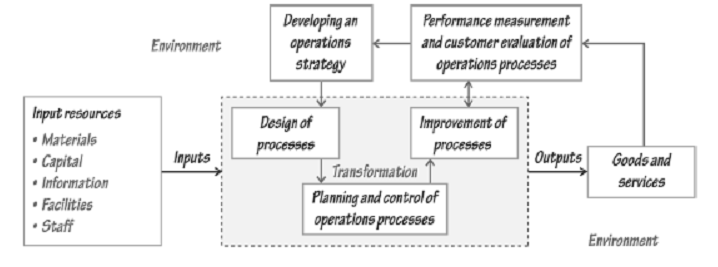
The operations function is concerned with the design of transformation processes, planning their use, and organising and controlling their day-to-day activities, ie how inputs can be acted upon to produce the required outputs, in the right quantities, of the right quality, at the right time. The operations function can control 70% of all assets. 

1. Operations can be viewed as a closed loop system. Systems display complex behaviour. 

2. Operations systems may be classified according to the extent to which products or services are made-to-order, assembled-to-order or made-for-stock. 

3. Operations systems may also be classified according to volume, variety or flexibility: project, job-shop, batch or continuous. 

4. Service operations may be usefully classified according to Schmenner's Matrix, according to their degrees of labour intensity and customisation/ customer interaction. 

5. As the service sector grows, it is increasingly apparent that service operations share many of the management problems encountered by production systems and can be described using the same theoretical constructs. 

6. Responsibilities of an operations manager and the interface with other functions such as marketing, people management and accounting and finance. 

7. The future challenges for operations managers especially in the service sector. 

8. Review of major stages in the evolution of operations: past, present and future. 

A general model of operations is illustrated in the following figure:
1533_Operations Function - Transformation Processes and Planning.png


Related Discussions:- Operations function - transformation processes and planning

Find an example where break-even analysis could be applied, In your own org...

In your own organisation find an example where break-even analysis is/could be applied.

Explain division of work (or labour), Explain Division of Work (or Labour)....

Explain Division of Work (or Labour). It is a famous principle of Economics, invented through  Adam Smith  who was the traditional economist. Fayol had advocated Division of wo

Compute the average number of customers waiting at lhs, During busy periods...

During busy periods, a new customer walks into LHS every 15 mins. (with a standard deviation of 15 mins). At SHC, a customer walks in every hour (with a standard deviation of 1 hou

Devise a regression equation or predict the profitability, Consider the tab...

Consider the table below. This time, the historical profitability of eight locations is listed in the table. Devise a regression equation and predict the profitability of a new sit

Explain the costs of the new systems that may be implemented, What are the ...

What are the costs of the new systems that may be implemented? How do we justify their implementation at Can Go?

Explain what are the advantages and disadvantages of each, Would you rather...

Would you rather work for a supervisor high in need for achievement, affiliation, or power? Why? What are the advantages and disadvantages of each? Explain

What are programmed decisions, What are programmed decisions? Decisions...

What are programmed decisions? Decisions made in accordance with several habit, rule or procedure are termed as Programmed Decisions.

LPP, A PAPER MILL PRODUCES TWO GRADES OF PAPER VIZ., X AND Y. BECAUSE OF RA...

A PAPER MILL PRODUCES TWO GRADES OF PAPER VIZ., X AND Y. BECAUSE OF RAW MATERIAL RESTRICTIONS, IT CANNOT PRODUCE MORE THAN 400 TONS OF GRADE X PAPER AND 300 TONS OF GRADE Y PAPER I

Abc analysis, how to find percentage of annual volume

how to find percentage of annual volume

Write Your Message!

Captcha
Free Assignment Quote

Assured A++ Grade

Get guaranteed satisfaction & time on delivery in every assignment order you paid with us! We ensure premium quality solution document along with free turntin report!

All rights reserved! Copyrights ©2019-2020 ExpertsMind IT Educational Pvt Ltd