Leadership in an oil production game, Game Theory

Assignment Help:

Leadership in an Oil Production Game

Students can be broken into pairs to play this game once, witheach student's representing one country; then each shouldswitch partners and play as if she were the other country.Students could also play this game individually, indicatingwhich action they choose when playing as each country; youcan pair sets of answers to show outcomes. This game is based on the Rational-Pigs game in John McMillan's Games, Strategies, and Managers; he uses the Saudi Arabia analogy onpage 14.

Ask students to consider a very simplified version of thesituation facing members of OPEC in the 1970s. In this sim-plified story, we assume that OPEC is made up of only twocountries-Saudi Arabia and Kuwait. Suppose that eachcountry can produce a unit of oil (maybe a million barrels)at a cost of $1. Saudi Arabia is a big country and can pro-duce either 4 or 5 units of oil; Kuwait is a small country andcan produce either 1 or 2 units of oil.

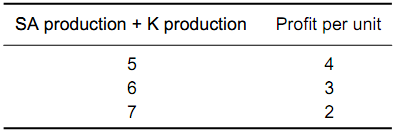
Given output and consumption in the rest of the world,the following formula tells us the price at which oil is sold:Price = 10 - (QS + QK), where QS is the number of unitsproduced by Saudi Arabia (SA), and QK is the number of units produced by Kuwait (K). Then profits are calculated as follows. If SA produces 4 units and K produces 1 unit, theprice of a unit of oil equals 5 (from the above formula). Be-cause the cost of producing a unit of oil equals $1, a countryearns a profit of $4 for each unit it makes. Because SA pro-duces 4 units, its total profit equals $16; because K produces 1 unit, its total profit equals $4. Profit per unit obviouslydepends on total production, as the following table illustrates:
1490_leadership in oil production game.png

Finally, tell students to put themselves in this situation,tell them to worry only about their own profits, and ask them:(1) How many units would you produce if you were SaudiArabia? (2) How many units would you produce if you were Kuwait?

When discussing this game, you can first collect studentinput on their choices, writing on the board the number of students who chose 4 as Saudi Arabia and 2 as Kuwait. Thenyou can show how the game can be analyzed more formally.It is nice to show that the symmetric version of the game (inwhich Saudi Arabia and Kuwait each choose either 2 or 3units) is a standard prisoners' dilemma; the smaller output level is the cooperative strategy. Once you change the choices available to the playersto be consistent with the description of the game and changethe payoffs accordingly, you will be able to illustrate how the analysis changes. Encourage students to provide hypothe-ses for why Saudi Arabia's incentives have changed andbuild on their ideas to show that large players often incur a much higher cost of cheating than do small players. Ask students to think of other examples of dilemma situations with leadership or provide some of your own. 


Related Discussions:- Leadership in an oil production game

Strategies against hostage takers, Strategies against Hostage Takers T...

Strategies against Hostage Takers T ypical Situations Terrorists: usually have several hostages, demands are polit- ical, may be fanatics, location may be public or sec

Two person, On a picnic outing, 2 two-person teams are playing hide-and-see...

On a picnic outing, 2 two-person teams are playing hide-and-seek. There are four hiding locations (A, B, C, and D), and the two members of the hiding team can hide separately in a

Incentive, A payoff offerd as a bequest for someone partaking in some activ...

A payoff offerd as a bequest for someone partaking in some activity that doesn't directly provide her with profit. Often, such incentives are given to beat the ethical hazard drawb

Game playing in class-equilibrium payoffs are (4, Equilibrium payoffs are (...

Equilibrium payoffs are (4, 5). Player A’s equilibrium strategy is “S then S if n and then N if n again.” Player B’s equilibrium strategy is “n if S and then n if S again and then

Calculate the expected payout, James and Dean are playing the Chicken game....

James and Dean are playing the Chicken game. They have noticed that their payout for being perceived as "tough" depends on the size of the crowd. The larger the crowd, the "cooler"

Game, The interaction among rational, mutually aware players, where the cho...

The interaction among rational, mutually aware players, where the choices of some players impacts the payoffs of others. A game is described by its players, every player's methods,

Hawk-dove game , Scenario The hawk-dove game is additionally commonly ca...

Scenario The hawk-dove game is additionally commonly called the sport of chicken. 2 hooligans with one thing to prove drive at one another on a slender road. The primary to swer

Simultaneous move games with mixed strategies, This chapter introduces mixe...

This chapter introduces mixed strategies and the methods used to solve for mixed strategy equilibria. Students are likely to accept the idea of randomization more readily if they t

Fictitious play , A method by that players assume that the methods of their...

A method by that players assume that the methods of their opponents are randomly chosen from some unknown stationary distribution. In every amount, a player selects her best respon

Pareto economical , Named when Vilfredo Pareto, Pareto potency (or Pareto o...

Named when Vilfredo Pareto, Pareto potency (or Pareto optimality) may be alive of potency. An outcome of a game is Pareto economical if there's no different outcome that produces e

Write Your Message!

Captcha
Free Assignment Quote

Assured A++ Grade

Get guaranteed satisfaction & time on delivery in every assignment order you paid with us! We ensure premium quality solution document along with free turntin report!

All rights reserved! Copyrights ©2019-2020 ExpertsMind IT Educational Pvt Ltd