Games with sequential moves-president liv problem , Game Theory

Assignment Help:

The most basic version of a LIV allows the executive office holder (Governor or President) to accept part of a bill passed by the legislature (so that part becomes law) and to veto (or reject) other parts of the bill. Without LIV power,the executive can only accept or reject whole bill. Obtaining LIV power thus appears to
give a governor more power than he or she had previously.

Dixit and Nalebuff ’s Thinking Strategically analyzes a situation like the following. Suppose that the U.S. President gets LIV authority. Suppose also that there are two distinct proposals (A and B) being debated in Washington. Congress likes proposal A; the President likes proposal B. These proposals are not mutually
exclusive; either or both (or none) may become law. There are thus four possible outcomes. The following table shows how the President and Congress rank the possible outcomes (where a larger number represents a more favorable outcome).
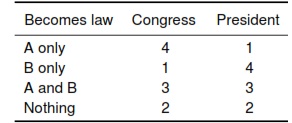
 

2483_game theory- president problem.jpg


The timing of the game between the Congress and the President is that Congress (may) pass a bill, which is then sent on to the President for him either to accept or to veto, in full or (if possible) in part. If the President does not have LIV power, this game can be illustrated with the tree on the top of page 13;
with LIV power, with the tree below it.


(a) Enter the payoffs for Congress and for the President (in that order) for all of the possible outcomes of both versions of this game.
(b) Using backward induction, describe a rollback equilibrium of the no-LIV game.
(c) Using backward induction, describe a rollback equilibrium of the with-LIV game.
(d) In this situation has the additional power given by line-item-veto authority helped or hurt the President? In your own words, explain why.
(e) For whichever of the two outcomes is worse for the President, describe (in your own words) what he or she might do to improve that outcome.

(f)  Suppose that outcomes were ranked in the way shown below. In this situation, would the President gain or lose from having LIV authority?


Solution:

Becomes law

Congress

President

A only

2

4

B only

3

1

A and B

4

3

Nothing

1

2


(b) Congress passes A and B together; the President signs the bill. Both A and B become law.

(c) Either Congress passes A only and the President vetoes it, or Congress passes nothing. Neither pro- posal becomes law.

(d) Hurt the president. Congress can’t count on him to sign the whole bill.

(e) The President could promise (see Chapter 9) to sign both bills. (f) LIV authority helps the President. With no LIV, A and B both become law. With LIV, only A

becomes law.


Related Discussions:- Games with sequential moves-president liv problem

Assurance game scenario, "Assurance game" is a general name for the game m...

"Assurance game" is a general name for the game more commonly known as "Stag Hunt." The French philosopher, Jean Jacques Rousseau, presented the subsequent circumstances. Two hunte

Identify the pure strategy equilibria, Consider the following three games (...

Consider the following three games (Chicken, Matching Pennies, Stag Hunt): Chicken Player 2 Player 1 D V D -100;-100 10;-10 V -10; 10 -1;-1 Matching Pennies Pla

Bidder''s choice, A multiunit auction mechanism for assigning heterogeneous...

A multiunit auction mechanism for assigning heterogeneous (different) objects. The highest bidder in the first round selects one item among those offered for sale. Then, a second r

Complete data, A game is one among complete data if all factors of the spor...

A game is one among complete data if all factors of the sport are common information. Specifically, every player is awake to all different players, the timing of the sport, and als

Game:claim a pile of dimes, GAME 1 Claim a Pile of Dimes Two players A...

GAME 1 Claim a Pile of Dimes Two players Aand B are chosen. The instructor places a dime on the table. Player A can say Stop or Pass. If Stop, then A gets the dime and the gam

Backward induction, Backward induction is an iterative procedure for resolv...

Backward induction is an iterative procedure for resolving finite general form or sequential games. First, one decides the finest policy of the player who makes the last move of th

Cournot learning, The Cournot adjustment model, initial proposed by Augusti...

The Cournot adjustment model, initial proposed by Augustin Cournot within the context of a duopoly, has players choose methods sequentially. In every amount, a firm selects the act

State the profit maximization problem of firm, 1. Consider two firms produc...

1. Consider two firms producing an identical product in a market where the demand is described by p = 1; 200 2Y. The corresponding cost functions are c 1 (y 1 ) = y 2 1 and c 2

Incentive, A payoff offerd as a bequest for someone partaking in some activ...

A payoff offerd as a bequest for someone partaking in some activity that doesn't directly provide her with profit. Often, such incentives are given to beat the ethical hazard drawb

Player , Any participant in a very game who (i)  contains a nontrivial s...

Any participant in a very game who (i)  contains a nontrivial set of methods (more than one) and (ii) Selects among the methods primarily based on payoffs. If a player is non

Write Your Message!

Captcha
Free Assignment Quote

Assured A++ Grade

Get guaranteed satisfaction & time on delivery in every assignment order you paid with us! We ensure premium quality solution document along with free turntin report!

All rights reserved! Copyrights ©2019-2020 ExpertsMind IT Educational Pvt Ltd