Instruction set architecture - assembly language, Computer Engineering

Assignment Help:

Instruction Set Architecture (ISA):

The Instruction Set Architecture (ISA) is the part of the processor which is noticeable to the compiler writer or programmer. The ISA serves as the limit amongst hardware and software. We will deeply describe the instruction sets found in several of the microprocessors used today. The ISA of a processor can be explained by using 5 categories:

Operand Storage in the CPU 

  •   Where are the operands reserved other than in memory?

Number of explicit named operands 

  •   How many operands are named in a distinctive instruction?

Operand location

Can be any no. of ALU instruction operand be located in memory? Or ought to be all operands are kept internally in the CPU?

Operations

What type of operations is provided in the ISA.?

Type and size of operands

What is the size and type of per operand and how is it mention?

 In all the above the most distinctive factor is the first. The most common types of ISAs are as following:

a. Stack: - The operands are put implicitly on top of the stack.

b. Accumulator:-One operand is implicitly mentions in the accumulator.

c. General Purpose Register (GPR) - All operands are explicitly specified, they are either memory locations or registers.

Assembly code of

A = B + C;

in all  of the above three architectures:
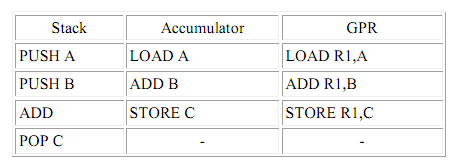
2412_Instruction Set Architecture - assembly language.png

Notice the fact that every processor may be neatly tagged into any 1 of the above categories. The i8086 contain much instruction that use implicit operands though it has a general register set. The i8051 is another instance, it has four banks of GPRs but most instructions might have the A register as one of its operands.


Related Discussions:- Instruction set architecture - assembly language

Explain real time systems, Q. Explain Real time system? A real time sys...

Q. Explain Real time system? A real time system defines an interactive processing system with severe time limitations. A real-time system is used whenever there are rigid time

Explain about registers, Q. Explain about Registers? A register is a gr...

Q. Explain about Registers? A register is a group of flip-flops that store binary information and gates that controls when and how information is transferred to register. An n-

What is cursor, The illustration of the mouse on-screen. Depending on your ...

The illustration of the mouse on-screen. Depending on your settings, the cursor can be many dissimilar things.

Set up a standard population model structure, Set up a standard population ...

Set up a standard population model structure. The population will begin with 24 people. We do not have actual data to support a birth rate, but we could calculate a reasona

Callable modules of program code within one abap/4 program, How can we crea...

How can we create callable modules of program code within one ABAP/4 program? We can create callable modules by two techniques:- By defining Macros. By creating incl

What do you mean by polynomial and exponential bounds, What do you mean by ...

What do you mean by polynomial and exponential bounds?   Bounds of the form nc for c greater than 0 .such a bound are known as polynomial bounds. Bounds of the form 2(n )  .suc

What are conditional chain statement, What are conditional chain statement?...

What are conditional chain statement? ON CHAIN-INPUT similar to ON INPUT. The ABAP/4 module is called if any one of the fields in the chain having a value other than its in

Advantage of doubly linked list over singly linked list, What is the advant...

What is the advantage of doubly linked list over singly linked list?       Ans: Benefits of the doubly linked list over singly linked list 1. A doubly linked list can be pas

Explain about the passive graphics device, Explain about the passive graphi...

Explain about the passive graphics device A passive graphics device simply draws pictures under computer control; i.e. it allows the computer to communicate graphically with th

Explain network security, Explain network security. Network security me...

Explain network security. Network security means the security of networks and their services from unauthorized access, changes, destruction or disclosure. It gives for assuranc

Write Your Message!

Captcha
Free Assignment Quote

Assured A++ Grade

Get guaranteed satisfaction & time on delivery in every assignment order you paid with us! We ensure premium quality solution document along with free turntin report!

All rights reserved! Copyrights ©2019-2020 ExpertsMind IT Educational Pvt Ltd