Illustration of marginal profit, Managerial Accounting

Assignment Help:

Illustration of Marginal profit

To illustrate the computations, suppose that the marginal profit or XE in our model is changed from 3 to 3 + δ1, where δ represents either positive or negative change. This means that the objective function reads as: Z = (3 + δ1) XE + 2XI.

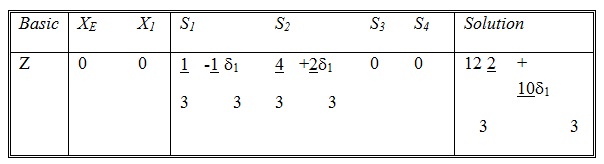
If we use this information in the starting tableau and carry out the same arithmetic operations used to produce the optimum tableau, the optimum Z equation will appear as:
1015_table1.jpg


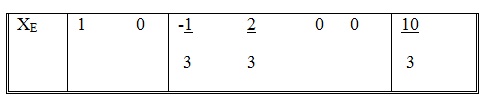
This equation is the same as the optimum Z equation before the change δ1 is effected, modified by terms of δ1. The coefficients of δ1 are essentially those in the XE equation of the optimum tableau, which are

Pivot Element
2322_table2.jpg


We choose the XE equation because XE is the variable whose objective coefficient is being changed by δ1.

The change δ1 will not affect the optimality of the problem as long as all the Z equation coefficients of the non-basic variables remain non-negative (maximization) that is:

1/3 - δ1/3 ≥0

4/3 + 2δ1/3 ≥ 0  

First Relationship  shows that δ1 ≥ 1 and the relation second yields δ1 ≥ -2.  Both relations limit δ1 by -2 ≤ δ1 ≤ 1. This means that the coefficient of XE can be as small as 3 + (-2) = 1 or as large as 3 + 1 = 4 without causing any change in the optimal values of the variables. The optimal value of Z, however, will change according to the expression 12 2/3 + 10/3 δ1 where -2 ≤ δ ≤ 1.

The foregoing discussion assumed that the variable whose coefficient is being changed has an equation in the constraints. This is true only if the variable is basic (such as XE and XI above). If it is non-basic, it will not appear in the basic column.

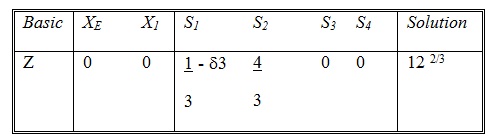
The treatment of non-basic variable is straight forward. Any change in the objective coefficient of a non-basic variable will affect only that coefficient in the optimal tableau. To illustrate this point, consider changing the coefficient of SI (the first slack variable) from 0 to 0 + δ3. If you carry out the arithmetic operations leading to the optimum tableau, the resulting Z equation becomes:
417_table3.jpg

It shows that the only change occurs in the coefficient of SI, where it is decreased by δ3. As a general rule, then, all we have to do in the case of a non-basic variable is to decrease the Z coefficient of the non-basic variable by the amount by which the original coefficient of the variable is increased.


Related Discussions:- Illustration of marginal profit

Case Study - Labor standards, Case Study Labor standards Geet...

Case Study Labor standards Geeta & Company has experienced increased production costs. The primary area of concern identified by management is direct labor. The compa

Show process of pricing under decline stage, Q. Show process of Pricing und...

Q. Show process of Pricing under decline stage? In this stage the producer should follow the pricing strategy which may fetch revenue not less than its cost of production. If h

Working capital, State Factors determining Working Capital requirement.

State Factors determining Working Capital requirement.

Explain decision unit - zero base budgeting, Explain decision unit - zero b...

Explain decision unit - zero base budgeting Decision units: an organization is divided among decision units. The manager of the decision unit justifies the relative budget

What are the features of product life cycle costing, Features of product li...

Features of product life cycle costing Product life cycle costing is important due to the following features: 1) product life cycle costing involves tracing of costs and re

TOTAL PRODUCTIVE MAINTENANCE, Identify the ways in which Total Productive M...

Identify the ways in which Total Productive Maintenance could be applied as part of a manufacturing organisation''s quality programme

Explain the methods of pricing, Explain the Methods of pricing The fol...

Explain the Methods of pricing The following methods are used for intra company transfer pricing: 1) Total cost method: transfer is made at absorption cost which is the t

Advance factoring and maturity factoring, Advance Factoring and Maturity Fa...

Advance Factoring and Maturity Factoring: In both recourse and non-recourse factoring whether the factor advances cash against book debts to the client instantly on assignment

Write Your Message!

Captcha
Free Assignment Quote

Assured A++ Grade

Get guaranteed satisfaction & time on delivery in every assignment order you paid with us! We ensure premium quality solution document along with free turntin report!

All rights reserved! Copyrights ©2019-2020 ExpertsMind IT Educational Pvt Ltd