Find intervals while function is increasing or decreasing, Mathematics

Assignment Help:

Find out all intervals where the given function is increasing or decreasing.

f ( x ) = - x5 + 5/2 x4 + 40/3 x3 + 5

Solution

To find out if the function is increasing or decreasing we will required the derivative.

f ′ ( x ) = -5x4 + 10x3 + 40x2

= -5x2 ( x2 - 2x - 8)

= -5x2 ( x - 4) ( x + 2)

Note as well that while we factored the derivative first we factored a "-1" out to make the rest of the factoring a little bit easier.

From the factored form of the derivative we illustrates that we have three critical points :x = -2 ,x = 0 , and x = 4 .  We'll require these in a bit.

Now we have to determine where the derivative is +ve and where it's -ve..  As the derivative is a polynomial this is continuous and thus we know that the only way for it to change signs is to primary go through zero.

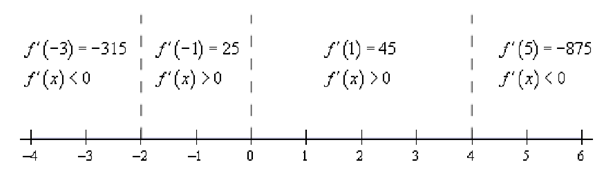
In other terms, the only place that the derivative might change signs is at the critical points of the function.  Now we've got another utilizes for critical points.  Thus, we'll build a number line, graph the critical points & pick test points through each region to illustrate if the derivative is positive or negative in each of region.

Following is the number line & the test points for the derivative.
316_function 1.png

Ensure that you test your points in the derivative. Recall that we know that the derivative will be the similar sign in each of region. The only place that the derivative can alter signs is at the critical points & we've marked the only critical points onto the number line.

Thus, it looks we've got the given intervals of increase & decrease.

Increase : - 2 < x <0 and 0 < x < 4

Decrease : - ∞ < x < -2 and 4 < x < ∞


Related Discussions:- Find intervals while function is increasing or decreasing

Diffrence between integers and rational numbers, Q. Give basic Diffrence be...

Q. Give basic Diffrence between Integers and Rational Numbers? Ans. Integers The integers are positive and negative whole numbers. The integers are closed under ad

Prove the boolean expression, Prove the subsequent Boolean expression: ...

Prove the subsequent Boolean expression: (x∨y) ∧ (x∨~y) ∧ (~x∨z) = x∧z Ans: In the following expression, LHS is equal to:   (x∨y)∧(x∨ ~y)∧(~x ∨ z) = [x∧(x∨ ~y)] ∨ [y∧(x∨

Estimate the greatest possible number of calculators, Martha has $20 to spe...

Martha has $20 to spend and would like to buy as several calculators as possible along with the money. The calculators that she needs to buy are $4.50 each. How much money will she

Example of fractional equations, Example of Fractional Equations: Exa...

Example of Fractional Equations: Example: Solve the fractional equation (3x +8)/x +5 =0 Solution: Multiply both sides of the equation by the LCD (x). (x) ((3x

Integers, hi i would like to ask you what is the answer for [-9]=[=5] grade...

hi i would like to ask you what is the answer for [-9]=[=5] grade 7

Class 10, The value of K for (k+1)x^2-2(k-1)x+1 = 0 has real and equal root...

The value of K for (k+1)x^2-2(k-1)x+1 = 0 has real and equal roots.

Sequencing model, theory about solving sequencing problem using graphical m...

theory about solving sequencing problem using graphical method

Write Your Message!

Captcha
Free Assignment Quote

Assured A++ Grade

Get guaranteed satisfaction & time on delivery in every assignment order you paid with us! We ensure premium quality solution document along with free turntin report!

All rights reserved! Copyrights ©2019-2020 ExpertsMind IT Educational Pvt Ltd