Find dispersion relation for free electron, Electrical Engineering

Assignment Help:

Find Dispersion Relation for Free Electron

Question: Find the dispersion relation for a free electron, and, thus, observe the relation between its rest mass and effective mass.

Solution: For a free electron, the electron momentum is  p =m0v = hk. Thus, E=m0V2/2=p2/ (2m0) = h2k2/(2m0). Therefore, the dispersion relation, i.e., E-k relation is parabolic. Hence, mx = h2/∂2Ε/∂K2=m0. This is a very interesting relation that says states that for a free electron, the rest mass and effective mass are one and similar, which is because of the parabolic band structure. Several materials have non-parabolic E-k relation, and, so they have quite different rest mass and effective mass for electrons.

Note: the effective mass may become a function of energy, for severely non-parabolic band structures, however, near the minima of the conduction band and towards the maxima of the valence band, the band structure can be taken to be parabolic, and, thus, an effective mass, which is independent of energy, may be obtained.

  • Thus, the effective mass is an inverse function of the curvature of the E-k diagram: weak curvature gives large mass, and strong curvature gives small mass.
  • Note that in general, the effective mass is a tensor quantity, however, for parabolic bands, it is a constant.
  • Another interesting feature is that the curvature d2E/dk2 is positive at the conduction band minima, however, it is negative at the valence band maxima.
  • Thus, the electrons near the top of the valence band have negative effective mass.
  • Valence band electrons with negative charge and negative mass move in an electric field in the same direction as holes with positive charge and positive mass.
  • Thus, the charge transport in the valence band can be fully accounted for by considering hole motion alone.
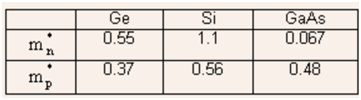
  • The electron and hole effective masses are denoted by m*n and m*p  respectively.


Table: the effective mass for electrons and holes (Χ m0, where m0 is the rest mass for electrons)311_Find Dispersion Relation for Free Electron.png

Related Discussions:- Find dispersion relation for free electron

Calomel electode, Explain the construction and working of Calomel electrode...

Explain the construction and working of Calomel electrode

Distribution centre capacity, Discuss the following points with regard to t...

Discuss the following points with regard to the Company selecting Jebel Ali Free Zone as its Middle East base.  (a) How is a company likely to enhance its supply chain by using

List few applications of microprocessor-based system, List few applications...

List few applications of microprocessor-based system. It is used: i. For measurements, display and control of current, voltage, temperature, pressure, etc. ii. For traff

Hardware requirement - gis technology, Hardware Requirement- Se...

Hardware Requirement- Server of adequate sizing for enterprise-wide deployment for storing maps and geospatial data. Application server and web server. Desktops

Cmos processes, CMOS processes: The low-performance "lateral" bipolar ...

CMOS processes: The low-performance "lateral" bipolar transistors occasionally employed in CMOS processes are sometimes designed symmetrically, i.e., with no distinction betwe

Realize various dividers in the schematic representation, Q. Counters are u...

Q. Counters are used to realize various dividers in the schematic representation of the digital clock shown in Figure. The blocks labeled "logic array" are logic gate combinations

Image frequency for an fm station, Q. Show that the image frequency for an ...

Q. Show that the image frequency for an FM station does not fall in the range of 88.1-107.9 MHz, regardless of the choice of high- or low-side local oscillator.

Explain the principle of a thermocouple, Explain the principle of a thermoc...

Explain the principle of a thermocouple. Give two examples of some common thermocouples. Thermocouples : They are used for the measurement of temperature. While two wires of v

Concept of flux density, We can illustrate the direction and strength of a ...

We can illustrate the direction and strength of a magnetic field by means of drawing 'flux lines'. These have arrows to show the direction of the magnetic field at any point and th

Write Your Message!

Captcha
Free Assignment Quote

Assured A++ Grade

Get guaranteed satisfaction & time on delivery in every assignment order you paid with us! We ensure premium quality solution document along with free turntin report!

All rights reserved! Copyrights ©2019-2020 ExpertsMind IT Educational Pvt Ltd