Explain working of cardiac pacemaker, Electrical Engineering

Assignment Help:

Q. Explain working of Cardiac Pacemaker?

When blockage occurs to the biological signals that stimulate the heart to beat, the application of electric pacemaker pulses forcing the heart to beat at a higher rate is very helpful. A demand pacemaker is particularly helpful to the patient with partial blockage, in which case an electric pulse to the heart muscle is only applied when a beat does not occur within a predetermined time interval.

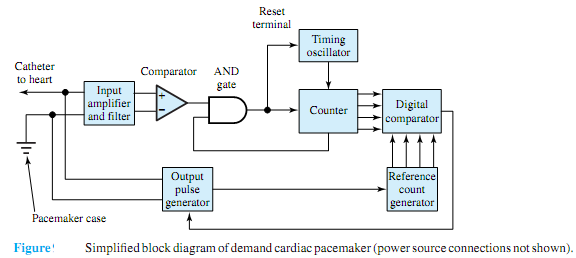
The pacemaker circuitry along with a lithium battery are enclosed in a metal case, which is implanted under the skin on the patient's chest. The mental case and the tip of the catheter (a wire enclosed in an insulating tube) form the electrical terminals of the pacemaker. A simplified block diagram of a typical demand pacemaker is shown in Figure.

The input amplifier amplifies the natural heart signals, which have a small amplitude on the order of 1 mV. Filtering eliminates certain frequency components so that heartbeats can be better detected. A comparative circuit is then used to compare the amplified and filtered signal with a threshold value and detect either a natural heartbeat or an output pacing pulse. This detection decision is passed on to the counting and timing circuitry through an AND gate. The second input to the AND gate comes from the counter circuit, such that input signals for 0.4 s after the start of a natural or forced beat are ignored.

The timing functions are performed by counting the output cycles of a timing oscillator, which generates a square wave with a precise period of 0.1 s. The digital signals produced by the counter are passed on to a digital comparator, which compares them with signals from a reference count generator and decides when the pulse generator is to deliver an output pulse of a specified amplitude and duration.
1699_Cardiac Pacemaker.png

Extremely low power consumption and high reliability become important criteria for all pacemaker designs.While electrical engineers can come upwith better circuit designs,mechanical and chemical engineers have to select better materials to produce the case and the catheter, and above all, the physicians have to provide the pacemaker specifications.Thus, doctors and engineers have to work in teams in order to develop better biomedical products.


Related Discussions:- Explain working of cardiac pacemaker

Number of holes in valence band, Number of holes in valence band: Der...

Number of holes in valence band: Derive the expression for number of holes in valence band and Fermi level in an intrinsic semiconductor. (b) By that percentage does the

Different kinds of high-tension fuses and low-tension fuses, Q. Different k...

Q. Different kinds of high-tension fuses and low-tension fuses ? Ans: There are two kinds of fuses they are a) L.V Fuses - 1) HRC cartridge fuses.   - 2) Semi enclosed re

Second generation 1954- 1964- history of computer , Second Generation ( 195...

Second Generation ( 1954- 1964) After the invention of semiconductor devices mainly transistors size of computer s was reduced a lot computing power increased reliability was

Advantages and disadvantages of direct coupled coupling, Q. Mention the adv...

Q. Mention the advantages and disadvantages of direct coupled coupling?       Advantages:             1.Simple circuit due to minimum use of resistor             2.Low

Zener diode, Zener Diode A Zener diode is a sort of diode that allows ...

Zener Diode A Zener diode is a sort of diode that allows current not only in the forward direction such as a normal diode, but as well in the reverse direction if the voltage

Explain the terms dielectric constant and dielectric loss, Explain the term...

Explain the terms dielectric constant and dielectric loss. Dielectric Constant or Permittivity: all insulating materials possess an electrical capacitance. The capacitance of

Reverse recovery characteristics, Reverse Recovery Characteristics At t...

Reverse Recovery Characteristics At the end of forward  conduction in diode  reverse current  flows for  a short  time. The  device  doesn't  attain its full blocking  capabili

Explain resistance-capacitance coupling, Q. Explain Resistance-capacitance ...

Q. Explain Resistance-capacitance coupling? It is the most commonly used coupling in discrete device amplifier as it is least expensive and has satisfactory frequency response.

Give the properties and application of brass, Give the properties and appli...

Give the properties and application of brass. Brass - It is an alloy of copper and zinc with 60 percent copper and 40 percent zinc. Its electrical resistivity of Brass is 7.0

Write Your Message!

Captcha
Free Assignment Quote

Assured A++ Grade

Get guaranteed satisfaction & time on delivery in every assignment order you paid with us! We ensure premium quality solution document along with free turntin report!

All rights reserved! Copyrights ©2019-2020 ExpertsMind IT Educational Pvt Ltd