Explain the electrode reactions and the cell reaction, Chemistry

Assignment Help:

Explain the Electrode reactions and the cell reaction?

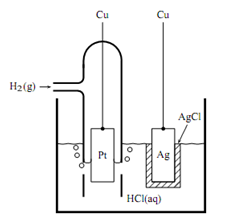
A cell diagram, with its designation of the left and right electrodes, allows us to write reaction equations for the cell. These equations are written according to the convention that electrons enter at the right terminal and leave at the left terminal. At each electrode there is an electrode reaction, or half-reaction, one for reduction at the right electrode and the other for oxidation at the left electrode. The reaction equations for the electrode reactions include electrons as either a reactant (at the right terminal) or a product (at the left terminal). The cell reaction describes the overall chemical change; its reaction equation is the sum of the equations for the two electrode reactants with cancellation of the electrons.
2043_Define the Elements of a galvanic cell.png

For instance, we can write the electrode reactions of the cell of Figure as follows.

906_Electrode reactions and the cell reaction 1.png

As written here, the stoichiometric numbers of the electrons have the same absolute value (2) in both reaction equations. This allows the electrons to cancel when we add the electrode reactions to form the cell reaction:

H2(g) + 2 AgCl (s) → 2H+ (aq) + 2 Cl- (aq) + 2 Ag (s)

The cell of Figure has a single electrolyte phase with essentially the same composition at both electrodes, and is an example of a cell without liquid junction or cell without transference. As an example of a cell with transference, consider the cell diagram

1929_Electrode reactions and the cell reaction 2.png

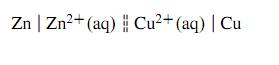
This is the zinc-copper cell depicted in Figure, sometimes called a Daniell cell. The two electrolyte phases are separated by a liquid junction represented in the cell diagram by the dashed vertical bar. If the liquid junction potential can be assumed to be negligible, the liquid junction is instead represented by a pair of dashed vertical bars:
1926_Electrode reactions and the cell reaction 3.png


Related Discussions:- Explain the electrode reactions and the cell reaction

Which the following sets of quantum numbers is not allowed, Which of the fo...

Which of the following sets of quantum numbers is not allowed : (1) n=1, l=0,m=0 s= +1/2                   (2) n=1, l=1,m=0 s= -1/2              (3) n=2, l=1,m=1 s= +1/2

The highest melting point, Which of the following has highest melting point...

Which of the following has highest melting point: (1)  BaCl 2                                             (2)  MgCl 2               (3)  Cacl 2

Dipole moment, why dipole moment of CH3CL is more than CH3F

why dipole moment of CH3CL is more than CH3F

Empirical formula, Find te emprical formula for the oxide that contains 42....

Find te emprical formula for the oxide that contains 42.05 g of nitrogen and 95.95 g of oxygen

Physical properties of acetone - aldehydes and ketones, Physical properties...

Physical properties of Acetone - Aldehydes and Ketones (a)  Acetone is a colourless liquid with characteristic pleasant odour. (b) Acetone is inflammable liquid. It boils at

The nature of bonding in graphite, The nature of bonding in graphite is: ...

The nature of bonding in graphite is: (1) Covalent                                       (2) Ionic     (3) Metallic (4) Coordinate Ans: Covalent

The frequency of yellow light having wavelength, The frequency of yellow li...

The frequency of yellow light having wavelength 600 nm is: (1) 5.0x10 14 Hz                 (2)  2.5 x 10 7 Hz        (3) 5.0x 10 7 Hz

Write Your Message!

Captcha
Free Assignment Quote

Assured A++ Grade

Get guaranteed satisfaction & time on delivery in every assignment order you paid with us! We ensure premium quality solution document along with free turntin report!

All rights reserved! Copyrights ©2019-2020 ExpertsMind IT Educational Pvt Ltd