Explain mesh - current method, Electrical Engineering

Assignment Help:

Q. Explain Mesh - Current Method?

This complements the nodal-voltage method of circuit analysis. A set of independent mesh-current variables that implicitly satisfy the KCL equations is selected in order to formulate circuit equations in this mesh analysis. An elementary loop,ora mesh, is easily identified as one of the "window panes" of the whole circuit. However, it must be noted that not all circuits can be laid out to contain only meshes as in the case of planar networks. Those which cannot are called nonplanar circuits, for which the mesh analysis cannot be applied, but the nodal analysis can be employed.

A mesh current is a fictitious current, which is defined as the one circulating around a mesh of the circuit in a certain direction. While the direction is quite arbitrary, a clockwise direction is traditionally chosen. Branch currents can be found in terms of mesh currents, whose solution is obtained from the independent simultaneous equations. The number of necessary equations in the mesh-analysis method is equal to the number of independent loops or meshes.
812_Mesh - Current Method1.png

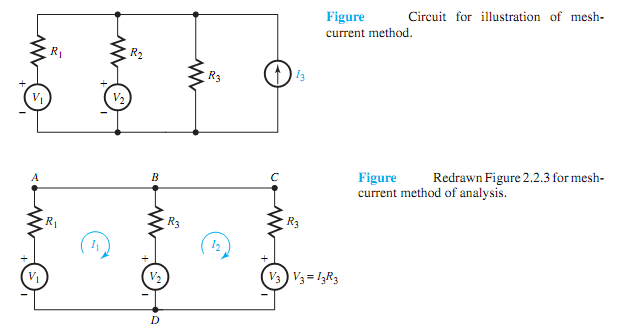
All current sourceswith shunt conductanceswill be replaced by their corresponding Thévenin equivalents consisting of voltage sources with series resistances. Let us illustrate the method by considering a simple, but typical, example, as shown in Figure (a).

Replacing the current sourcewith shunt resistance by the Thévenin equivalent, Figure (a) is redrawn as Figure (b), in which one can identify two elementary loops, or independent meshes.

By assigning loop or mesh-current variables I1 and I2, as shown in Figure (b) , both in the clockwise direction, one can write the KVL equations for the two closed paths (loops) ABDA and BCDB,

1575_Mesh - Current Method.png


Related Discussions:- Explain mesh - current method

Calculate the amplitude of the dc component, A periodic voltage consists of...

A periodic voltage consists of sinusoidal pulses having an amplitude of 150 V (SEE DIAGRAM BELOW). Use Fourier Series Expansion to calculate: 1.       the amplitude of the DC co

Digital electronics, Design a 4-bit synchronous counter that has the follow...

Design a 4-bit synchronous counter that has the following sequence: 0 ?4? 9?12 ? 14 ?15 and repeat using: i) JK FF ii)D FF

Explain about frequency shift keying, Q. Explain about Frequency Shift Keyi...

Q. Explain about Frequency Shift Keying? In this scheme frequency of the carrier signal is changed according to the data. Transmitter sends different frequencies for a "I" than

Utilization of electrical energy, Ask question #Discuss the role of load fa...

Ask question #Discuss the role of load factor on the cost of electrical energy 100 words accepted#

Calculate the value of the wavelength, In an electron microscope, a beam of...

In an electron microscope, a beam of electrons is produced by a device called an electron gun. In the electron gun, electrons are 'boiled off' from a heated filament (which is the

Calculate the magnetic flux in the core, Q. A toroid with a circular cross ...

Q. A toroid with a circular cross section is shown in Figure. It is made from cast steel with a relative permeability of 2500. The magnetic flux density in the core is 1.25 Tmeasur

Determine the duration of the frame, Four voicemessages, each with 3-kHz ba...

Four voicemessages, each with 3-kHz bandwidth, are to be sampled at Nyquist rate, and time- multiplexed with samples taken at twice the Nyquist rate from six analog monitoring sign

Electrical circuits and systems, Electrical circuits and systems : Elec...

Electrical circuits and systems : Electrical systems allow energy to be conveniently delivered from the point of supply to the point of application - e.g. electric railways, ca

Write Your Message!

Captcha
Free Assignment Quote

Assured A++ Grade

Get guaranteed satisfaction & time on delivery in every assignment order you paid with us! We ensure premium quality solution document along with free turntin report!

All rights reserved! Copyrights ©2019-2020 ExpertsMind IT Educational Pvt Ltd