Explain error-rate control and output-rate control, Electrical Engineering

Assignment Help:

Error-Rate Control, Output-Rate Control, and Integral-Error (Reset) Control

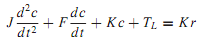
Let us consider a typical second-order servomechanism(containing two energy-storing elements) whose defining differential equation for obtaining the dynamic behavior of the system is given by
2338_Error-Rate Control and Output-Rate Control.png

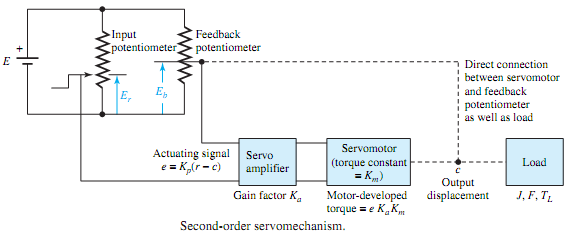
where J, F, and TL represent, respectively, effective inertia, equivalent viscous friction, and resultant load torque appearing at the motor shaft; K = KpKaKm, where Kp is the potentiometer transducer constant (V/rad), Ka is the amplifier gain factor (V/V), and Km is the motor-developed torque constant (N·m/V) of the physical servomechanism shown in Figure; r is the input command and c is the output displacement, both in radians.

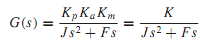
The block diagram of the servomechanism of Figure is given in Figure, in which the transfer function of each component is shown. Since the actuating signal is given by E = Kp(R - C), the block diagram may be simplified, as shown in Figure, in which TL is assumed to be zero for simplicity. The direct transmission function (forward path transfer function) for the system can be seen to be
2419_Error-Rate Control and Output-Rate Control1.png

The corresponding closed-loop transfer function is given by

 

555_Error-Rate Control and Output-Rate Control2.png

882_Error-Rate Control and Output-Rate Control3.png


Related Discussions:- Explain error-rate control and output-rate control

Discuss description of insulating materials, Discuss description of insulat...

Discuss description of insulating materials on the basis of physical and chemical structure Insulating materials, on the basis of their physical and chemical structure may be d

Explain segment assembler directive, Explain SEGMENT assembler direct...

Explain SEGMENT assembler directive with example. SEGMENT: This directive described to the assembler the start of a segment along with name segment-name. The seg

Complete the timing diagram of an sr latch, Complete the timing diagram of ...

Complete the timing diagram of Figure of an SR latch.

Sinusoidal expression for the current, The voltage across a 1 - μF capaci...

The voltage across a 1 - μF capacitor is given. Which is the sinusoidal expression for the current? a) 30 sin200t b) 70cos (800t - 20°) At what frequency will the re

Electrons, Ask question #Minimum 100 words accepted how does the charge pla...

Ask question #Minimum 100 words accepted how does the charge plate relate to the movement of electrons

Metering and billing system, Metering and Billing System Previously, y...

Metering and Billing System Previously, you have learnt about various measures for reducing commercial losses of a utility. You have studied in which the metering and billing

What do you mean by conductors and insulators, Q. What do you mean by Condu...

Q. What do you mean by Conductors and Insulators? In order to put charge in motion so that it becomes an electric current, one must provide a path through which it can flow eas

Calculate the maximum analog output voltage, Q. For the 4-bit D/A converter...

Q. For the 4-bit D/A converter of Figure, calculate: (a) The maximum analog output voltage. (b) The minimum analog output voltage. (c) The smallest detectable analog outpu

Threshold switching voltage, Analogue Threshold switching a) Include a...

Analogue Threshold switching a) Include a variable potential divider to the schematic diagram to control the transistor base voltage b) Include the potential divider compon

Tvm, Why is the signal first attenuated and then amplified?

Why is the signal first attenuated and then amplified?

Write Your Message!

Captcha
Free Assignment Quote

Assured A++ Grade

Get guaranteed satisfaction & time on delivery in every assignment order you paid with us! We ensure premium quality solution document along with free turntin report!

All rights reserved! Copyrights ©2019-2020 ExpertsMind IT Educational Pvt Ltd