Execute privilege, PL-SQL Programming

Assignment Help:

EXECUTE Privilege

To call an invoker-rights routine straightforwardly, the users should have the EXECUTE privilege on that routine. By yielding the privilege, you permit a user to

(i)                 Call the routine straightly

(ii)                Compile the functions and procedures which call the routine

Assume that the user till grants the EXECUTE privilege on invoker-rights routine fft to the user app, as shown below:

GRANT EXECUTE ON util.fft TO app;

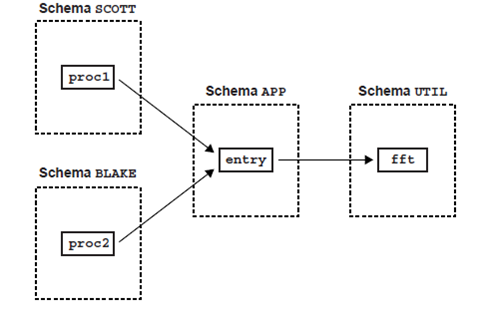
Now, the user app can compile the functions & procedures which call the routine fft. At run time, no privilege checks on the calls are completed. So, as figure shows, the user need not grant the EXECUTE privilege to every user who may call the fft indirectly.
307_execute previlige.png

Figure: Indirect Calls to an Invoker-Rights Routine

Note that that routine till fft is called directly only from the definer-rights routine app.entry. Therefore, the user till should grant the EXECUTE privilege only to the user app. When util.fft is executed, its invoker may be scott, app, or blake.


Related Discussions:- Execute privilege

Naming conventions-pl/sql, Naming Conventions The similar naming conventi...

Naming Conventions The similar naming conventions apply to all PL/SQL program items and units including the variables, cursors, constants, cursor variables, procedures, exception

PROCEDURE, Create a procedure named DDPROJ_SP that retrieves project inform...

Create a procedure named DDPROJ_SP that retrieves project information for a specific project based on a project ID. The procedure should have two parameters: one to accept a projec

Literals in pl/sql, Literals A literal is an explicit numeric, string...

Literals A literal is an explicit numeric, string, character, or Boolean value not represented by an identifier. Numeric literal 147 and the Boolean literal FALSE are some of

Varrays versus nested tables, Varrays versus Nested Tables The Nested ta...

Varrays versus Nested Tables The Nested tables are differing from varrays in the following ways: 1)  Varrays have a maximum size, while nested tables do not. 2)  Varrays are

Updating by replacement, Updating by replacement Syntax: UPDAT...

Updating by replacement Syntax: UPDATE ENROLMENT SET Name = 'Ann' WHERE StudentId = SID ('S1'); Note the use of SET, as already noted in connection with direct a

Example of unwrap operator - sql, Example of UNWRAP Operator - SQL Exa...

Example of UNWRAP Operator - SQL Example here shows how unwrapping can be done in longhand in SQL. Example: Unwrapping in SQL Letting CONTACT_INFO_WRAPPED denote the res

Parameter and keyword description - fetch statement, Parameter and Keyword ...

Parameter and Keyword Description: cursor_name: This identifies an explicit cursor formerly declared within the present scope. cursor_variable_name: These identif

Forward declarations - subprograms, Forward Declarations The PL/SQL ne...

Forward Declarations The PL/SQL needs that you declare an identifier before using it. And hence, you should declare a subprogram before calling it. For illustration, the decla

%notfound - explicit cursor attributes, %NOTFOUND The %NOTFOUND is log...

%NOTFOUND The %NOTFOUND is logical, opposite of the %FOUND. The %NOTFOUND yields FALSE if the last fetch returned a row, or TRUE when the final fetch failed to return a row. I

Example of wrap operator - sql, Example of WRAP Operator - SQL The eff...

Example of WRAP Operator - SQL The effect of Example can be obtained in SQL but note that one needs to write down not only the names of the columns being wrapped but also the

Write Your Message!

Captcha
Free Assignment Quote

Assured A++ Grade

Get guaranteed satisfaction & time on delivery in every assignment order you paid with us! We ensure premium quality solution document along with free turntin report!

All rights reserved! Copyrights ©2019-2020 ExpertsMind IT Educational Pvt Ltd