Estimate total dissolved solids, alkalinity and hardness, Civil Engineering

Assignment Help:

Estimate total dissolved solids, Alkalinity and Hardness

A sample of water from Brazos River at Brenham was collected and analyzed for water quality characteristics and the data is presented in the table below (regular font).  Estimate (i) total dissolved solids. (ii) Alkalinity (iii) hardness (TH, CH and NCH)

  (Data is shown in Columns 1 and 2 other columns are part of solution)
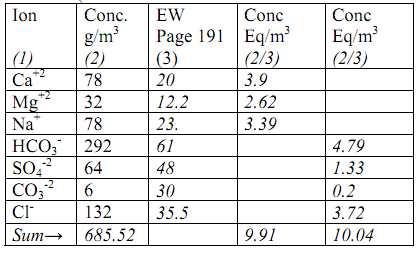
1836_Estimate total dissolved solids, Alkalinity and Hardness.png

(i) Note that the sum of cations and anions should be roughly equal (in eq/m3) for a satisfactory analysis.

Total dissolved solids (TDS) = sum of all the ions in column 2 = 685.52 g/m3

(ii) Alkalinity is caused by the presence of mainly CO3-2 and HCO3 - ions (For all practical purposes the contribution of hydroxyl (OH-) and Hydrogen (H+) ions to alkalinity is negligible for natural waters)

Alkalinity (eq/m3) = CO32- + HCO3- = 4.79 + 0.2 = 4.99 eq/m3

(also remember that 1 eq/m3 = 50 mg/l as CaCO3)

(iii) Total Hardness, TH (add all the cations with a charge of 2 or more)

TH = Ca+2 + Mg+2 =

3.9 + 2.62 = 6.52 eq/m3 (or 326 mg/l as CaCO3)

Carbonate Hardness (CH) = bicarbonate + carbonate (However, CH cannot be more than TH)

= 4.79 +0.2 = 4.99 eq/m3 (250 mg/l as CaCO3)

Non-Carbonate Hardness (NCH) = TH - CH = 6.52-4.99 = 1.53 eq/3 (To obtain values in mg/L as CaCO3 multiply eq/m3 with 50 or use the column with mg/L as CaCO3).


Related Discussions:- Estimate total dissolved solids, alkalinity and hardness

Explain foundation design discharge for a bridge, Q. Explain Foundation des...

Q. Explain Foundation design discharge for a bridge? To provide for an adequate margin of safety against any abnormal flood exceeding the design discharge (Q), the foundations,

Cone, if the diameter of the base remains constant by what factor should th...

if the diameter of the base remains constant by what factor should the altitude be multiplied to produce a cone with twice volume as the original

Determine the time of settlement of a sand particle, Using Stokes' law, det...

Using Stokes' law, determine the time of settlement of a sand particle of 0.2 mm size (specific gravity 2.67) through a depth of water of 30 cm. The viscosity of water is 0.001 N-s

Pros and cons of a variety of non-destructive weld methods, Question In...

Question In checking quality of weld, what are pros and cons of a variety of non-destructive weld inspection methods as in ultrasonic test, radiographic inspection and magnetic

Concrete, What is Polymer Concrete?

What is Polymer Concrete?

Need Answer, EXPLAIN THE STRUCTURE OF EXOGENEOUS TREE WITH DIAGRAM ?

EXPLAIN THE STRUCTURE OF EXOGENEOUS TREE WITH DIAGRAM ?

Energy dissipation at outlets - typical drainage outlet, Q. Energy dissipat...

Q. Energy dissipation at outlets - typical drainage outlet? Flow velocity at outlets is generally high. Without proper control of this energy, subsequent bank erosion can resu

Determine the specific gravity of solids, The Atterberg limits of a clay so...

The Atterberg limits of a clay soil are: Liquid limit = 63%, Plastic limit = 40%, and shrinkage limit = 27%. If a sample of this soil has a volume of 10 cm 3 at the liquid limit a

Write Your Message!

Captcha
Free Assignment Quote

Assured A++ Grade

Get guaranteed satisfaction & time on delivery in every assignment order you paid with us! We ensure premium quality solution document along with free turntin report!

All rights reserved! Copyrights ©2019-2020 ExpertsMind IT Educational Pvt Ltd