Q. Concept of Development of binomial nomenclature?
Name is a conventional tool to act as means of reference. For example, when we say chimpanzee, sparrow, paddy, virus, we mean to refer certain wild animal, bird, cultivated plant ad virus respectively. Thus the words mentioned above are the names. Let us have an example to give the concept of nomenclature. Suppose a farmer with half a dozen cows might refer to each animal by descriptive phrases as the long horned red cow and short horned white cow etc. But when his herd of cows increases he might have more than one long homed red cow and he would be more inclined to designate each cow with a short individual name, not necessarily descriptive in character.
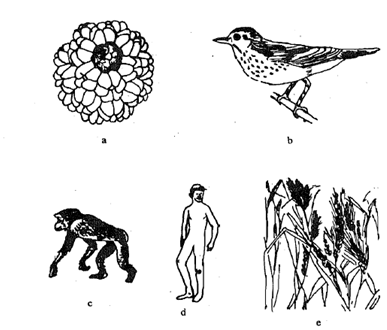
You should know that there are two trends in naming organisms. The one for the convenience of the layman termed as vernacular or common name and. the others are scientific names.. Virus, sparrow, chimpanzee, man and paddy are examples of common names and turnip yellow mosaic virus, Passer domesticus, Macacus macaque; Homo sapiens and oryza sativa are the scientific names for virus, sparrow, chimpanzee, human and paddy respectively.
Seldom used in more than one language and differ district to district, state to state and country to country. These are applied arbitrarily and there is no conscious attempt to indicate relationship between organisms. For example, "Tamala" is a beautiful flowering evergreen tree and is known by common name s' like Dample, Otor and Tamala in Hindi. Dampel, 0th and Osth in Marathi and Karnal and Ota in Gujarati. Paddy is commonly known as Chaval in Bihar, Uttar Pradesh and Madhya Pradesh, as Dhana in Orissa, as Nellu in Madras and Bhatta in Mysore Similarly, House-sparrow is known as Moineau in France, Gomion in Spain, Pardal in Portugal, Passer in Italy and House-operling in Germany. In order to overcome the deficiencies and uncertainties arising from the use of local expressions the concept of technical designation or scientific name developed. This is now known as Binomial Nomenclature and is applied to biological organisms both plants and animals. This nomenclature is followed world-wide. For example "House-sparrow" is universally known by its only scientific name Parser domestics Linn. The advantage of scientific name is its definiteness as compared to the vareties found inzommon names.