Determine the final stresses in the bolt, Civil Engineering

Assignment Help:

Determine the final stresses in the bolt:

A steel bolt of diameter 12 mm and length 175 mm is used to clamp a brass sleeve of length 150 mm to a rigid base plate as in Figure. The sleeve has an internal diameter of 25 mm and a wall thickness of 3 mm. The thickness of the base plate is 25 mm. Initially, the nut is tightened until there is tensile force of 5 kN in the bolt. The temperature is now increased by 100°C. Determine the final stresses in the bolt and the sleeve.

For computation purposes, take following values:

Eb = 105 GNm-2 ; Es = 210 GNm-2

αb = 20 × 10 -6 K-1 ; αs = 12 × 10 -6 K-1
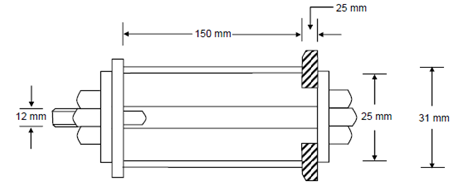
1419_Determine the final stresses in the bolt.png

Figure

Solution

Let the free thermal expansions of steel and brass be Δs and Δb and Δ be the common expansion. Then

Δs = (175) (12 × 10-6) (100) = 0.21 mm

Δb = (150) (22 × 10-6) (100) = 0.3 mm

If the initial stresses in steel and brass due to 5 kN load are σs1 and σb1, then

σs1 = +( 5 × 103 × 4)/π (12)2 = + 44.21 N/mm2                       (Tensile)

σb1 = +( 5 × 103 × 4)/π (312 - 252) = + 44.21 N/mm2           (Compressive)

Equilibrium of thermal stresses σs2 and σb2 requires that

 σs2 × π (12)2/4 +σb2 × π (312  - 252 )/4 = 0

or        3 σs2 + 7 σb2 = 0

The thermal strains are given by

εs = (Δ- Δs )/175 and εb  = (Δ- Δb )/150

Thus, the thermal stresses are as follows:

σs2 = 210/175 (Δ- Δs) × 103 N/mm2

and σb2 = 105/150 (Δ- Δb) × 103 N/mm2

Substituting these in the equilibrium equation,

3 × 210/175 (Δ - 0.21) × 103 + 7 × 10⁵/150 (Δ - 0.30) × 103 = 0

Hence,            Δ = 0.262 mm

Thus,

σs2 = 210/175 (0.262- 0.21) × 103 = + 62.26 N/mm2                            (Tensile)

σb2 = 105/150 (0.262- 0.3) × 103 = - 26.28 N/mm2                (Compressive)

Total stresses are therefore as follows:

σs = σs1 + σs2 = - 106.5 N/mm2       (Tensile)

σb = σb1 + σb2 = - 4.56 N/mm2       (Compressive)


Related Discussions:- Determine the final stresses in the bolt

Defects of timber, what are defects in timber occur due to natural causes?

what are defects in timber occur due to natural causes?

Fillet welding, Strength of member when fillet welded

Strength of member when fillet welded

Shear stress, difference between bending stress and shear stress

difference between bending stress and shear stress

#transportation engineering sessional.., #how the result of DETERMINATION O...

#how the result of DETERMINATION OF THE 10 PERCENT FINES value can be interprited?

Stone tiles for construction material, Q. Stone tiles for construction mate...

Q. Stone tiles for construction material? For Public toilet bath rooms kitchen etc. we may be use stones tiles ( marble , kota stone , Polished Kuddapa stone or polished Dhura

Maintenance of steel bearings, Q. Maintenance of steel bearings? Cleani...

Q. Maintenance of steel bearings? Cleaning and greasing of bearings is one of the important maintenance works to avoid premature failure of bearings and reduce recurring heavy

Abrasion test - tests on stones, Abrasion Test:   This test is carri...

Abrasion Test:   This test is carried out on stones used as aggregates for road construction. The test result shows the suitability of stones against   the grinding action u

Epoxy-coated bars vs galvanized bars, Bonding performance to concrete: Epox...

Bonding performance to concrete: Epoxy-coated bars vs. galvanized bars  Based on the findings of CEB Bulletin 211 the bonding of galvanized bars to concrete is lower in early

Write Your Message!

Captcha
Free Assignment Quote

Assured A++ Grade

Get guaranteed satisfaction & time on delivery in every assignment order you paid with us! We ensure premium quality solution document along with free turntin report!

All rights reserved! Copyrights ©2019-2020 ExpertsMind IT Educational Pvt Ltd