Determine the exaggeration produced by the two lens system, Physics

Assignment Help:

Q. (a) Determine the'effective  focal length' of the grouping of the two lenses in Exercise 9.10 if they are placed 8.0 cm a part with their principal axes  coincident. Performed the answer depend on which side of the combination a beam of parallel light is incident? Is the idea of effective focal length of this system useful at all? (b)T he object 1.5 cm in size is placed on the side of the convex lens in the arrangement (a) above. The distance among the object and the convex lens is 40cm.  Determine the exaggeration produced by the two < lens system and the size of the image.

Answer

A Focal length of the convex lens, f1=30cm

A Focal length of the concave lens, f2=-20cm

The Distance between the two lenses d=8.0cm

(a)While the parallel beam of light is incident on the convex lens first:

As-per to the lens formula we have

2429_Determine the exaggeration produced by the two lens system.png

Where

U1=Object distance=∞

v1=Image distance

v2=Image distance
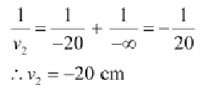
1528_Determine the exaggeration produced by the two lens system1.png

The image will perform as a real object for the convex lens.

Pertaining lens formula to the convex lens, we have:
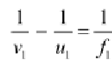
1753_Determine the exaggeration produced by the two lens system2.png

Where,

U1=Object distance

=- (20+d)=-(20+8)=-28cm

V1=Image distance
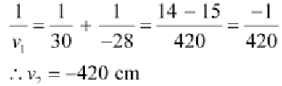
2365_Determine the exaggeration produced by the two lens system3.png

Therefore the parallel incident beam appears to diverge from a point that is (420-4) 416 cm from the left of the centre of the combination of the two lenses.

The answer does depend on the side of the combination at which the parallel beam of light is incident. The notion of effectual focal length does not seem to be useful for this combination.

(b)Height of the image h 1=1.5cm

An Object distance from the side of the convex lens u1=-40cm

|u1|=40cm

As-per to the lens formula:
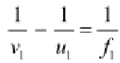
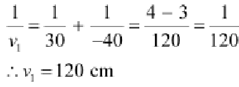
1447_Determine the exaggeration produced by the two lens system4.png

Where v1=Image distance

1017_Determine the exaggeration produced by the two lens system5.png

Magnification=120/40=3

Therefore the magnification due to the  convex lensis3.

The image produced by the convex lens acts as an object for the concave lens .According to the lens formula:
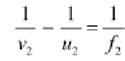
5_Determine the exaggeration produced by the two lens system6.png

Where

U2=Object distance

=+ (120-8)=112cm.

V2 =Image distance
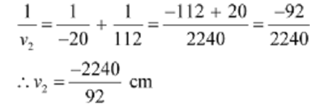
1080_Determine the exaggeration produced by the two lens system7.png

Magnification 1335_Determine the exaggeration produced by the two lens system8.png

= 2240/92 x 1/112  = 20/92

Therefore the magnification due to the concave lens is 20/92.

The magnification produced by the grouping of the two lenses is calculated as

m x m'

= 3 x 20/92 = 60/92  = 0.652

The magnification of the grouping is given as
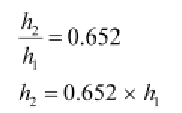
2113_Determine the exaggeration produced by the two lens system9.png

Where

h1= Object size=1.5cm

h2 = Size of the image

194_Determine the exaggeration produced by the two lens system10.png

Therefore the height of the image is 0.98 cm.


Related Discussions:- Determine the exaggeration produced by the two lens system

Will a dc motor actually produce voltage, Will a DC motor actually produce ...

Will a DC motor actually produce voltage if it is spun in reverse? It'll make voltage if you spin it forwards, too. The only difference among a DC motor and a DC generator is w

What is radium used for, What is radium used for? Radium was formerly u...

What is radium used for? Radium was formerly used in self-luminous paints for nuclear panels, watches, aircraft switches, clocks, and instrument dials. More than 100 former wat

Give one example for thermoplastic and thermosetting, Give one example each...

Give one example each for thermoplastic and thermosetting polymers Thermoplastics - Polyethylene, PVC etc. Thermosetting plastics - Bakelite (Phenolfomaldehyde resin), Urea

Explain scattered electrons made strong diffraction pattern, Davisson and G...

Davisson and Germer scattered electrons from a crystal of nickel.  The scattered electrons formed a strong diffraction pattern. What important conclusion was drawn from this experi

Waves, a wave of eqn y=0.005sin(8x-3t).find displacement when x=0.3 t=20s?i...

a wave of eqn y=0.005sin(8x-3t).find displacement when x=0.3 t=20s?in the answer given y=0.005sin(80*3-0.3*20)= y=0.005sin(-36+12pi).what is this 12pi?

What frequency of light is emitted from the helium atom, A helium atom is i...

A helium atom is in a galaxy travelling at a speed of 4.89 x 10 6 m/s away from the Earth. An astronomer on Earth observes a frequency from the helium atom of 6.52 x 10 14 H

Explain the applications of polarization of light, Explain the applications...

Explain the applications of polarization of light?  Write any four applications of interference of light. Illustrate how plane polarized light obtained by reflection.

The stoplight- 1-dimensional kinematics, The Stoplight- 1-Dimensional Kinem...

The Stoplight- 1-Dimensional Kinematics A blue car moving at a constant speed of 10 m/s passes a red car which is at rest. This occurs at a stoplight the moment in which the li

Write Your Message!

Captcha
Free Assignment Quote

Assured A++ Grade

Get guaranteed satisfaction & time on delivery in every assignment order you paid with us! We ensure premium quality solution document along with free turntin report!

All rights reserved! Copyrights ©2019-2020 ExpertsMind IT Educational Pvt Ltd