Describe the types of triangles, Mathematics

Assignment Help:

Describe the Types of triangles ?

Triangles can be classified according to the lengths of the sides or the measures of the angles.

1. Naming triangles by sides
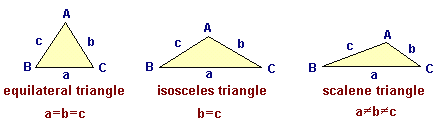
754_wquilateral triangle.png

An equilateral triangle is a triangle with three congruent sides.
An isosceles triangle is a triangle with at least two congruent sides.
A scalene triangle is a triangle with no congruent sides.

In an isosceles triangle DABC, if @ , and are called legs of the isosceles triangle,  B and  C are called base angles and  A is called the vertex angle.

2 Naming triangles by angles
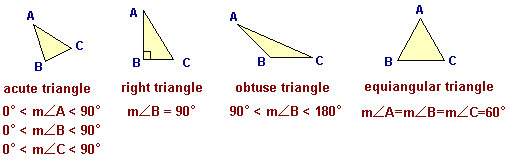
1574_acute triangle.png

An acute triangle is a triangle with three acute angles.
A right triangle is a triangle with a right angle.
An obtuse triangle is a triangle with an obtuse angle.
An equiangular triangle is a triangle with three congruent angles.
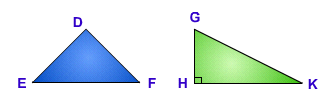
2093_triangle1.png

In a right triangle, the side opposite the right angle is called the hypotenuse, the sides that form the right angle are called legs.

Exercise 5.1

Name the legs, base angles and vertex angle in DDEF. Assume that
Name the legs and hypotenuse in DGHK. Assume that mH = 90.
1769_triangle2.png

Definition 5.1

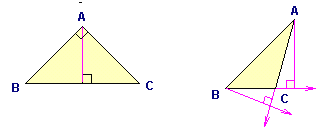
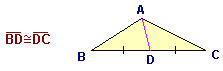
An altitude of a triangle is a segment from a vertex to a point on the opposite side (perhaps extended) and the segment is perpendicular to the opposite side.
949_triangle3.png

Note that in a right triangle two of the altitudes coincide with the legs of the right triangle. In an obtuse triangle two altitudes have feet on the extension of the sides.

Definition 5.2

A median of a triangle is a segment drawn from a vertex of a triangle to the midpoint of the opposite side.


Related Discussions:- Describe the types of triangles

Explain peano''s axioms with suitable example, Question 1 Explain Peano's ...

Question 1 Explain Peano's Axioms with suitable example Question 2 Let A = B = C= R, and let f: A→ B, g: B→ C be defined by f(a) = a+1 and g(b) = b 2 +1. Find a) (f °g

Construction, draw a equilateral triangle with length of side 6.5 cm. and l...

draw a equilateral triangle with length of side 6.5 cm. and let us draw a parallelogram equal in area to that triangle and having an angle 45 degree

The distributive law, The Distributive Law :  If you were asked to mentall...

The Distributive Law :  If you were asked to mentally multiply 37 with 9, how would you proceed? 1 would do it as follows - 37 is 30 + 7, 30 x 9 = 270, 7 x 9 = 63, so 270 + 63, th

Standard errors of the mean, Standard errors of the mean The series of ...

Standard errors of the mean The series of sample means x¯ 1 , x¯ 2 , x¯ 3 ........ is normally distributed or nearly so as according to the central limit theorem. This can be

Sketch a graph of the microphone signal, Figure shows noise results for a p...

Figure shows noise results for a prototype van measured on a rolling road. The vehicle had a four-cylinder-in-line engine. The engine speed was varied in 3rd gear from just above

Solve the subsequent proportion, Solve the subsequent proportion: Exa...

Solve the subsequent proportion: Example: Solve the subsequent proportion for x. Solution: 5:x = 4:15 The product of the extremes is (5)(15) = 75. The produ

Prove that ar= 3/7 ac of parallelogram , ABCD is a parallelogram in the giv...

ABCD is a parallelogram in the given figure, AB is divided at P and CD and Q so that AP:PB=3:2 and CQ:QD=4:1. If PQ meets AC at R, prove that AR= 3/7 AC. Ans:    ΔAPR ∼ Δ

Write Your Message!

Captcha
Free Assignment Quote

Assured A++ Grade

Get guaranteed satisfaction & time on delivery in every assignment order you paid with us! We ensure premium quality solution document along with free turntin report!

All rights reserved! Copyrights ©2019-2020 ExpertsMind IT Educational Pvt Ltd