Derivatives with chain rule, Mathematics

Assignment Help:

Chain Rule : We've seen many derivatives.  However, they have all been functions similar to the following kinds of functions.

R ( z ) = √z      f (t ) = t 50                    y = tan ( x )         h ( w) = ew       g ( x ) =ln x

These are all rather simple functions in that wherever the variable appears it is by itself.  What about functions as the below given,

1221_chain scale.png

On these functions none of our rules will work and still some functions are closer to the derivatives which we're liable to run into than the functions in the first set.

For example let's take the first one.  On the definition of the derivative actually we used the definition to calculate this derivative. In that section we found that,
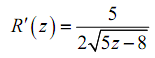
2306_chain scale1.png

If we were to only utilizes the power rule on this we would get,
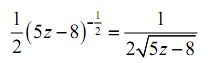
922_chain scale2.png

that is not the derivative which we computed using the definition.  It is close, although it's not the similar.  Thus, the power rule alone won't work simply to get the derivative here.

Let's keep looking at this function and note as well that if we define,

f ( z )= √z        g ( z ) = 5z - 8

then we can write function as a composition.

2176_chain scale3.png

and it turns out that actually it's fairly simple to differentiate a function composition by using the Chain Rule. There are two forms of chain rule.  Following they are.


Related Discussions:- Derivatives with chain rule

Gravity, There is a list of the forces which will act on the object. Gr...

There is a list of the forces which will act on the object. Gravity, F g The force because of gravity will always act on the object of course. Such force is F g   = mg

Test of homogeneity , Test of homogeneity This is concerned along with...

Test of homogeneity This is concerned along with the proposition that several populations are homogenous along with respect to some characteristic of interest for example; one

Limits, Limits The concept of a limit is fundamental in calculus....

Limits The concept of a limit is fundamental in calculus. Often, we are interested to know the behavior of f(x) as the independent variable x approaches some

Functions, find the domain of the function f(x) = (| sin inverse sin x | - ...

find the domain of the function f(x) = (| sin inverse sin x | - cos inverse cos x) ^ 1/2

Find all the real solutions to cubic equation, Find all the real solutions ...

Find all the real solutions to cubic equation x^3 + 4x^2 - 10 =0. Use the cubic equation x^3 + 4x^2 - 10 =0 and perform the following call to the bisection method [0, 1, 30] Use

What is a lattice, What is a lattice? Which of the following graphs are lat...

What is a lattice? Which of the following graphs are lattice and why? Ans:  Let (L, ≤) be a poset. If each subset {x, y} consisting of any two elements of L, comprises a glb (I

Write Your Message!

Captcha
Free Assignment Quote

Assured A++ Grade

Get guaranteed satisfaction & time on delivery in every assignment order you paid with us! We ensure premium quality solution document along with free turntin report!

All rights reserved! Copyrights ©2019-2020 ExpertsMind IT Educational Pvt Ltd